What Binance’s US lawsuit says about the future for cryptocurrency regulation

(Andrew Urquhart, University of Reading and Hossein Jahanshahloo, Cardiff University) The world’s largest cryptocurrency exchange, Binance, has been hit with a lawsuit by US regulator the Commodity Futures Trading Commission (CFTC). This is not the first time a cryptocurrency exchange has been charged by a regulator. But this particular case involves a regulator that does not directly oversee cryptocurrencies. This indicates how regulators – particularly those in the US – hope to clamp down on the cryptocurrency industry.

The CFTC’s lawsuit alleges that Binance violated US derivatives laws by offering its derivative trading services to US customers without registering with the right market regulators. It says Binance has prioritised commercial success over regulatory compliance.

The CFTC has also levied charges against Binance’s founder and CEO, Changpeng Zhao (known as CZ) and former chief compliance officer Samuel Lim. They are charged with taking steps to violate US laws, including directing US-based “VIP customers” to open Binance accounts under the name of shell companies. The regulator has pointed to chat messages as evidence of CZ and Sim’s knowledge of various criminal groups using the exchange.

People visit Binance nearly 15 million times a week to trade on the over 300 cryptocurrencies it offers in more than 1,600 different markets. CZ is an outspoken advocate for cryptocurrencies and regularly tweets about the industry and his company. He even tweeted a link to his initial response to the recent CFTC charges, which he called “unexpected and disappointing”. Promising full responses in due time, he said:

Upon an initial review, the complaint appears to contain an incomplete recitation of facts, and we do not agree with the characterization of many of the issues alleged in the complaint.

Last year CZ’s tweets arguably contributed to the collapse of FTX, one of his company’s main rivals. Binance saw its market share grow following FTX’s collapse.

So, this charge – against not only a crypto giant but also the company of an outspoken industry advocate – has created further upheaval in a market that has already suffered multiple crises in the last year. Investors withdrew a reported US$1.6 billion (£1.3 billion) from Binance within days of the CFTC’s announcement of its charges. These outflows could continue if US regulators tighten their squeeze on crypto companies further, causing major players like Binance to shift focus to other jurisdictions.

Creeping oversight

The CFTC aims to “protect the public from fraud, manipulation, and abusive practices related to the sale of commodity and financial futures and options, and to foster open, competitive, and financially sound futures and option markets”. Previous actions by this regulator in 2021 against Tether and Bitfinex resulted in major fines and a loss of credibility for the crypto industry.

But a statement published at the time by one of the CFTC’s five commissioners, Dawn Stump, pointed out that the CFTC doesn’t actually have responsibility for regulating cryptocurrencies. She warned that these fines might “cause confusion about the CFTC’s role in this area”. She said the action was based on defining stablecoins (a type of cryptocurrency) as a commodity, but: “we should seek to ensure the public understands that we do not regulate stablecoins and we do not have daily insight into the businesses of those who issue such”.

These latest charges against Binance focus on its activities in derivatives – financial contracts that are linked to the value of an asset such as oil or, in this case, cryptocurrencies. This is a market the CFTC does regulate.

Another US financial regulator, the Securities and Exchange Commission (SEC), has also been ramping up its crypto oversight activities. As well as focusing on the Initial Coin Offering market, it saw a 50% increase in enforcement actions against digital asset companies last year compared to 2021.
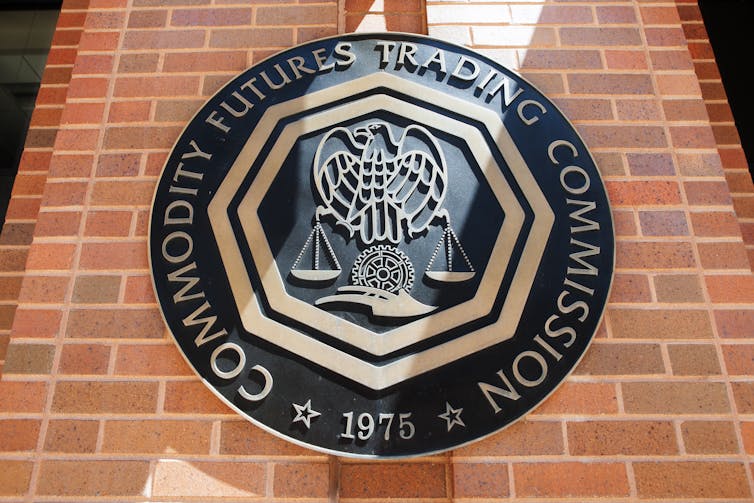
Black and gold emblem of the US Commodity Futures Trading Commission in Washington, DC, brick wall background.

Crypto market changes

So, Binance is up against two powerful US financial regulators. Some experts have warned that “significant regulatory action could prompt Binance to increasingly shift its business operations beyond the United States”. Certainly, the fact that Binance held a 92% share of the crypto market at the end of 2022 means it facilitates many transactions and offers a lot of liquidity to traders around the world, including in the US.

A trader’s capacity to find competitive prices when buying and selling, as well as sources of liquidity (or other people to trade with) would be affected by the loss of or pull back of one of the world’s top ten crypto exchanges. This would be bad news for retail and institutional investors who could be confronted with a smaller and potentially more expensive market as a result.

And even if the complaints and investigations by the CFTC and SEC take a while to conclude, as is likely, the US legislature may step in before that. A report published by the Financial Times days after the CFTC announcement alleges that Binance has hidden links to China for many years. A statement issued by the the exchange to the FT said this is not “an accurate picture of Binance’s operations” and that the paper’s sources were “citing ancient history (in crypto terms)”.

But recent actions against Chinese tech company Huawei and social media platform Tiktok indicate political leaders are keen to crack down on Chinese companies’ access to US technology systems and customer data. So any similar concerns could lead US politicians to start acting in this area as well.

Andrew Urquhart, Professor of Finance & Financial Technology, ICMA Centre, Henley Business School, University of Reading and Hossein Jahanshahloo, Assistant Professor in Finance, Cardiff University

This article is republished from The Conversation under a Creative Commons license. Read the original article.

The Conversation

NFL 2026: por qué el fútbol americano (el deporte y sus valores) importa más que nunca (y por qué el show de medio tiempo es lo de menos)

(Por Maqueda, Taylor, Ortega y Maurizio) En 2026, cuando el Super Bowl es también un fenómeno de entretenimiento global, conviene defender una idea simple y casi contracultural: lo más relevante del fútbol americano no es lo que pasa en el escenario del entretiempo, sino lo que pasa en el campo… y lo que ese campo ha enseñado durante más de un siglo sobre la cultura competitiva de Estados Unidos. 

Lectura de alto valor estratégico, 4 minutos de lectura, material idea para compartir)

Adrenalina y estrés: un cóctel peligroso (¿qué tipo de personalidad y qué tipo de organización fomentan este común flagelo?)

(Por la Dra. Sonia Abadi, una cocreación para la prestigiosa comunidad Beyond en colaboración con Infonegocios Miami) Creemos que la adrenalina es energía, excitación, motivación. En realidad, la adrenalina es la hormona de la lucha y, por lo tanto, una respuesta física ante situaciones que producen miedo. 

(Lectura de alto valor estratégico, 4 minutos de lectura, material idea para compartir)

Jurassic Park y el WiFi (Xfinity) "funciona" en el Super Bowl LIX: la nostalgia se convierte en el ecosistema phydigital más ambicioso de 2026

(Por Maqueda-Taylor-Maurizio) Hay un momento en la historia de la publicidad donde un spot deja de ser un spot. Donde un anuncio de 60 segundos se transforma en un organismo vivo que respira en calles, pantallas, algoritmos, conversaciones y emociones colectivas. 

 (Lectura de alto valor estratégico, 4 minutos de lectura, material idea para compartir)

Super Bowl LX: la masterclass de estrategia que todos debemos aprender para el 2026 (y aplicarla en los negocios)

(Taylor-Ortega, colaboración Maurizio) Bajo las luces del Levi's Stadium, no se coronó solo a un campeón de la NFL. Se escribió el manual de una nueva era, donde la estrategia pura, ejecutada con precisión quirúrgica por una defensa joven (Cross de experiencia, muchas capacidades, juventud y mucho trabajo de equipo) derrotó a la tradición, “técnica” y fuerza.

(Lectura de alto valor estratégico, 4 minutos de lectura, material idea para compartir)

Super Bowl LIX: Bad Bunny cayó en audiencias en TV y no rompió los récords de Usher y Kendrick Lamar, ni MJ (¿por qué medios dijeron lo contrario?)

(Por Maqueda-Maurizio-Taylor) Los datos finales de Nielsen para el Halftime Show del Super Bowl LIX son una cápsula de verdad en un mar de hipérbole digital. 128.2 millones de espectadores. No es un récord. Es, de hecho, una caída de 5.3 millones respecto al pico de 133.5 millones de 2025. 

(Lectura de alto valor estratégico, 4 minutos de lectura, material ideal para compartir)

El "Billionaire Bunker" no es una moda, es una estrategia geopolítica de élite (el manual no escrito al que se suscribe Zuckerberg)

(Por Taylor desde Silicon Beach, edición Maurizio) Cuando Mark Zuckerberg compra una propiedad en Indian Creek Village —esa isla privada de 41 mansiones apodada "Billionaire Bunker"— no está comprando una casa. Está adquiriendo una opción estratégica en el tablero geopolítico del capital global. Y con él, se completa una trinidad sagrada: Bezos (Amazon), Page (Google), Zuckerberg (Meta). Los tres fundadores del ecosistema digital que define el siglo XXI ahora tienen su búnker en el mismo kilómetro cuadrado de Florida.

(Lectura de valor, 4 minutos de lectura, material idea para compartir)

Inter Miami CF se corona como el club más valioso de la MLS (valuación histórica de U$$ 1.450 millones)

(Por ORTEGA) Inter Miami CF no solo hace historia en la cancha. Según Sportico, medio especializado en valuaciones deportivas a nivel global, la franquicia de Florida se consolida como el club más valioso de la Major League Soccer (MLS), con una valoración récord de USD$ 1.450 millones, marcando un crecimiento interanual del 22%, el más alto de la liga.

(Lectura de valor, 3 minutos de lectura, material idea para compartir)

Kylie Jenner y SKIMS: por qué esta campaña no es solo moda (una muestra más de la compleja era de las colaboraciones, phigitalidad y ecosistemas de marca)

(Por Vera- Rotmistrovsky y Maurizio) Esta colaboración, aparentemente sencilla, es en realidad un caso de estudio en estrategia de expansión de categorías, uso inteligente de celebridades y –sobre todo– una lección magistral en cómo conectar lo físico y lo digital en la mente del consumidor.

(Lectura de valor, 4 minutos de lectura, material idea para compartir)

El gran error estratégico que la mayoría de marcas comenten (y que otras como Ferrari, Adidas, Mercedes y LVMH, corrigieron)

(Por Maurizio y Maqueda) Entre 2015 y 2020, una generación de marketineros —sobreestimulados por la fiebre de las métricas digitales— cometió uno de los errores estratégicos más costosos de la historia del mundo de los negocios: declarar muerto el marketing experiencial y físico. 

(Lectura de valor, 4 minutos de lectura, material idea para compartir)