More of us are facing pet separation anxiety than ever before. Dog ownership surged with pandemic lockdowns and working from home. Now, with the boundaries between work and home already so blurred, shouldn’t every inclusive, caring employer embrace an open-doggy-door policy?
What’s the harm? After all, isn’t there a growing body of research showing the benefits of pets in the workplaces?
Maybe. Yes, pets certainly can bring benefits to the workplace. These include reducing stress and improving social interaction and job satisfaction.
But the same studies showing benefits, and that most people support pet-friendly workplace, also highlight the risks, hazards and concerns that must be considered for a pet-friendly workplace to be inclusive, equitable and sustainable.

Dogs aren’t for everyone
Not everyone loves dogs. Some people just don’t like them, and a small percentage fear them – a condition called cynophobia.
A commonly reported number of how many this affects is 5% of the population, but this is likely US-specific, with rates differing by country and culture. Global studies suggest about 3.8% have a lifetime animal phobia (2% of men, 5.4% of women), including dogs and cats.
About 10–20% of the global population are allergic to dogs or cats. This rate is increasing.
But 100% of workers have a right to feel safe and not have their health compromised at work.
This doesn’t automatically rule out a pet-friendly policy, but it does require exploring and addressing all these issues adequately.
Equity matters
Does everyone get to bring their pet to work?
If the boss can because they have a separate office but those sharing a open-plan space can’t, it’s likely to cause resentment.
The time spent petting, feeding or taking a dog for toilet breaks may also stoke negative feelings among some colleagues.

What about those with other types of pets? Some cats also suffer separation anxiety. Parrots (budgerigars, cockatiels, conures and others) also form strong attachments to humans and can become highly stressed when left alone.
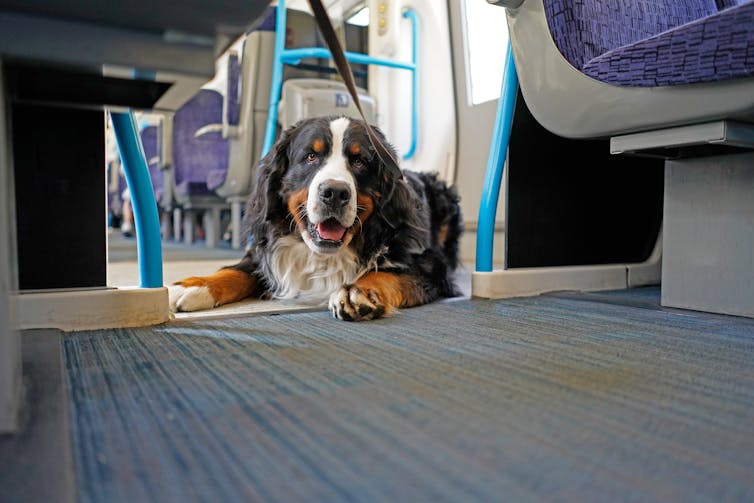
Getting to work is also an equity issue. In many countries a pet-friendly workplace will require driving to work, because only registered assistance animals are allowed on public transport and in public spaces. It’s unfair if the only workers able to take advantage of a pet-friendly workplaces are those who can drive.
What’s in it for the dog?
Even though most dog owners want to take their dog to work, it’s very important to ask if that really is in your pet’s best interest.
Yes, dogs are a highly social species; and yes, your dog likes to be around you. But, like humans, not every dog is a people person. For some dogs home is their safe space. Even with their “human” they may be stressed away from it.
Dogs, being sensitive to human emotions, may well feel stressed by your workplace if it also stresses you.
Other animal issues to consider include the presence of other dogs.
Organisational factors
A workplace therefore needs to consider multiple factors to make a pet-friendly policy work.
It needs to ensure the feelings of all workers have been considered, and whether the policy favours some at the expense of others.
In needs to ensure the work space is suitable for both human and animal well-being and hygiene. Though dogs’ space needs vary enormously, even the smallest dog needs space out of walkways and kick zones – being under a desk is not really suitable – as well as ready access to water bowls and outdoor toileting areas.

It needs policies codifying expected standards of behaviour – both human and animal. This may include requiring proof of proper socialisation, such as a certificate of basic obedience.
It needs procedures mapping out all contingencies. Owners should be responsible for cleaning up after their dogs and ensuring they do not cause disruption. But whose insurance will cover potential animal or human injuries, or damage to property? Do workers’ compensation policies cover animal-related incidents?
How to make pet-friendly work
It may seem we’re focusing on barriers to workplaces being dog-friendly. But assessing and addressing all the risks makes the likelihood of success much greater.
A useful document to help work through all the issues is the Pets at Work Tookit (funded by pet food maker Mars Petcare) which covers things from making a case to senior management to how to create a workplace pet policy.
Another useful document is the Safe Animal Friendly Environments multi-species companion-animal risk management tool developed in 2021 by University of South Australia researchers for the UK’s Society for Companion Animal Studies.
Though designed specifically to promote people entering aged care to keep their pets, this document includes a comprehensive list of risks, responsibilities and mitigation actions.

So if taking your dog to work appeals to you, chat to your colleagues, identify the issues and put a policy in place.
It may prove to be a great thing for your colleagues, you and most of all your dog.
Janette Young, Lecturer in Health Promotion, University of South Australia and Saravana Kumar, Professor in Allied Health and Health Services Research, University of South Australia
This article is republished from The Conversation under a Creative Commons license. Read the original article.
