Alibaba: Between the Challenge of Chinese Statism and Hope in the Global Market

(By Taylor and Maurizio, with the collaboration of Maximiliano Mauvecin). In a more internal and competitive analysis, Alibaba, a giant that if it were in the USA, Ireland, Germany, El Salvador, or any free country, could today be among the top 3 strongest companies in the world. E-commerce is advancing rapidly, and Alibaba Group Holding Limited has become an iconic name. However, the recent turbulence in its finances and market performance has raised concerns among investors and analysts. As the company faces significant operational challenges, from the slowdown of e-commerce in China to uncertainty in its international expansion strategy, it is crucial to understand the current context and future implications for this giant of digital commerce.

Summary and Tips IN


  • IG: @infonegociosmiami


This article explores five key challenges that Alibaba currently faces: the stagnation of e-commerce in China, the weak growth of its cloud services, the sustainability of its international expansion, the withdrawal of the IPO from its logistics division, and the increase in its market multiples.

Key Challenges for Alibaba

  1. E-commerce Performance in China: A Worrying Growth

The e-commerce segment in China, which includes platforms like Taobao and Tmall, is the main revenue generator for Alibaba. However, its performance has been disappointing. In the last quarter of fiscal year 2024, the company reported only 4% growth compared to the previous year, reflecting a decline from the 6% growth in the first nine months of the same year. This stagnation occurs in a context where competition, especially from companies like PDD Holdings with its Temu platform, intensifies, making it even harder for Alibaba to regain its momentum.

  1. Cloud Services: Stagnant Growth Despite Incentives
Despite efforts to incentivize the use of its cloud services, including price reductions on over 100 products, Alibaba has not seen a significant increase in sales. Revenue growth from its Cloud Intelligence Group remained at a modest 3% during the last quarter of FY24. Although the company has expressed its intention to prioritize high-quality revenue and AI-related products, the lack of improvement in EBITDA margins raises questions about the effectiveness of this strategy.

  1. International E-commerce: Can Growth Be Sustained?
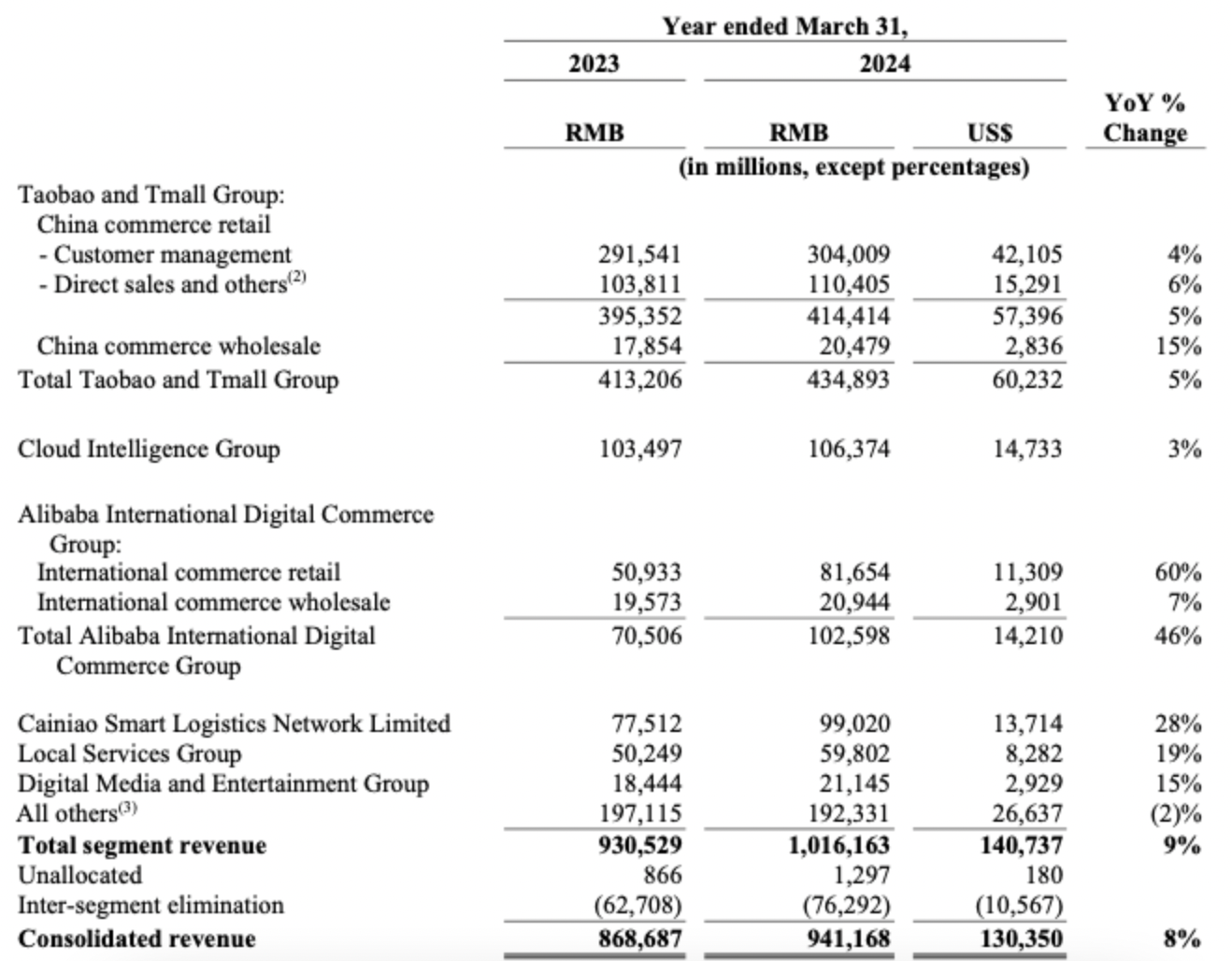


Alibaba's international segment, which includes its international digital commerce unit, has shown impressive growth of 46%. However, this growth raises questions about its sustainability. Trade tensions between China and the United States, along with concerns about labor practices and national security, could limit Alibaba's ability to expand into Western markets. The recent decision not to spin off its cloud services division also reflects a cautious strategy in the face of an uncertain international environment.

  1. Logistics: The Withdrawal of the Cainiao IPO
Alibaba's logistics division, Cainiao Smart Logistics Network, has also experienced healthy revenue growth of 28%. However, the recent cancellation of its IPO has generated concern. Although it was justified as a measure to foster synergies with the e-commerce division, the reality is that this decision could be related to an unfavorable market environment and the pursuit of a better valuation in the future. Such changes in the company's structure could indicate a lack of clarity in Alibaba's overall strategy.

  1. Market Multiples: An Uncertain Landscape
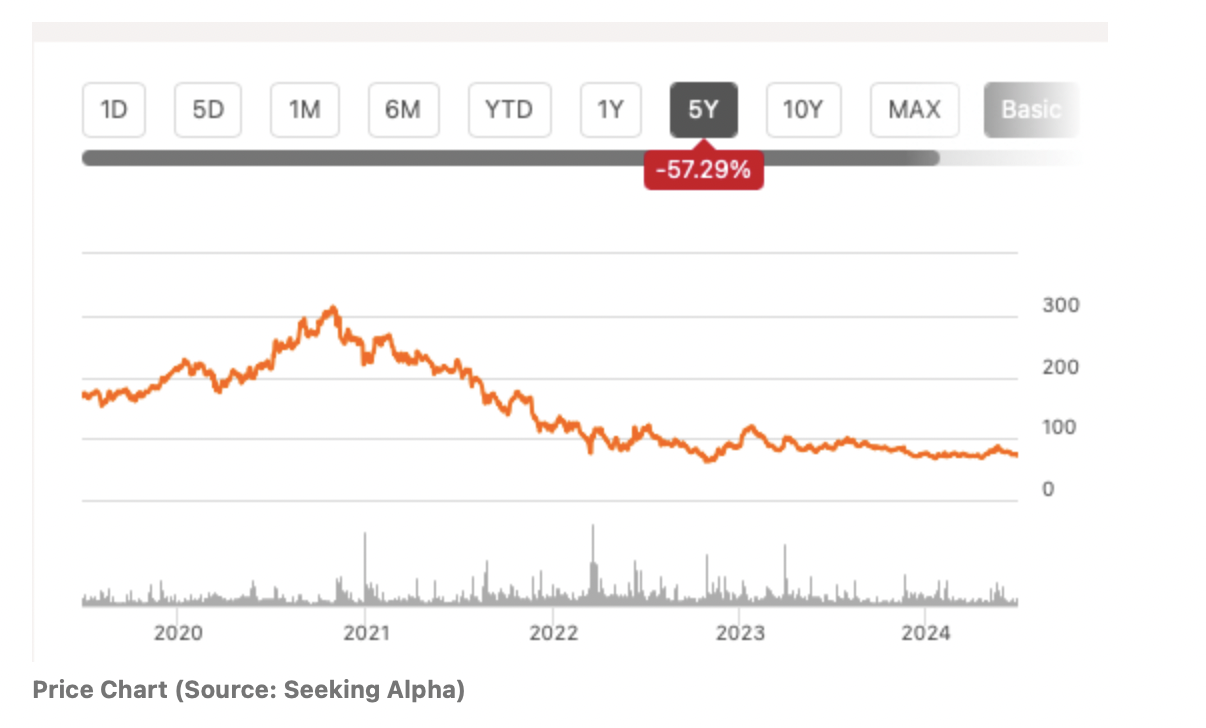
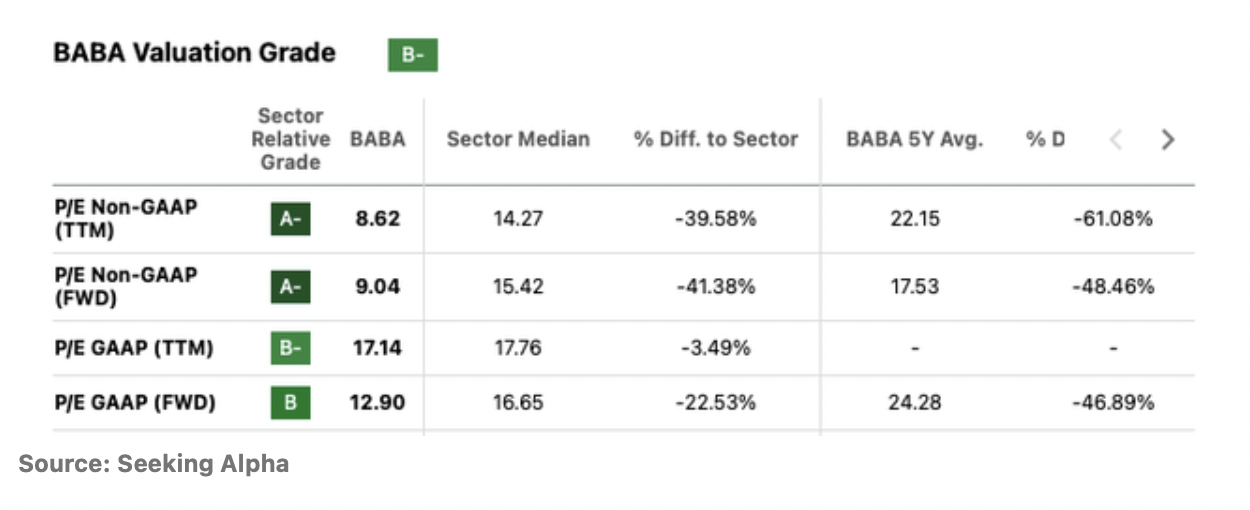
Although Alibaba's market multiples appear competitive compared to five-year averages, the recent increase in its price-to-earnings (P/E) ratio raises questions. With a 96% contraction in net income in the last quarter of FY24, and an expectation of a decrease in earnings per share for FY25, analysts are cautious. If current trends continue, Alibaba's multiples could lose attractiveness, further complicating its financial outlook.

Conclusion: An Uncertain Future

Despite Alibaba's efforts to communicate with its investors and offer a long-term vision, the current challenges are undeniable.

The company faces a complex environment, with financial performance failing to recover and an international strategy threatened by external factors, where the Chinese state has yet to take the step that all entrepreneurs in the country and the rest of the world hope it will take, towards freedom and respect for private and individual property.

This would not only enhance its leadership in quantitative terms but would also dramatically improve trust, relationships, experience, and ultimately, the most important aspects: the quality and value of its economy, empathy, and security in what is most decisive and meaningful for the human being—full freedom.


 

Registrate sin cargo, ahora, aquí.

El trofeo invisible pero invaluable que ganó Norris (lo que nadie te cuenta sobre ser campeón en la F1, hoy)

(Por Juan Maqueda en equipo con Mauricio, Martinez Bueno, Destefano y la comunidad Ristretter) Cuando Lando Norris levantó aquel trofeo de 5,5 kilogramos en Abu Dhabi, el mundo vio el clímax de una historia deportiva. Pero lo que realmente ocurrió ese día representa una lección magistral en branding personal, economía del entretenimiento y construcción de legado que Miami – epicentro del show business latinoamericano – debería estudiar con lupa microscópica.

(Tiempo de lectura de valor: 4 minutos)

Norris campeón mundial: ¿cómo queda el mapa global actualizado de pilotos y naciones que forjaron los 35 campeones de la F1?

(Por Juan Maqueda en equipo con Mauricio, Martinez Bueno, Destefano y la comunidad Ristretter) Detrás de cada campeón de Fórmula 1 hay dos banderas: la de su nacimiento y la de su equipo. Hoy, tras la consagración de Lando Norris, presentamos el análisis definitivo de las fuerzas geopolíticas y empresariales que dominan el deporte motor mundial.

(Tiempo de lectura de valor: 4 minutos)

Adidas despliega su arma secreta en Londres: el "Hybrid Hotel" (una muestra más de la era del ecosistema-crossing de expansión de categorías)

(Por Maurizio y Rodriguez Otero) Qué más necesitas ver para entender que todo lo que sabías de marketing y del “retorno” quedó absolutamente caduco. "Hybrid Hotel" No es un hotel. Es un manifiesto físico del regreso de la expansión de las experiencias y de categorías a niveles de universos de marca. 

(Tiempo de lectura de valor: 4 minutos)

Messi campeón con Inter Miami: “Estoy muy feliz" (la ciudad, todos los negocios, los medios, las marcas y anglolatina, también)

(Por Ortega desde el Chelsea Stadium, con Maqueda y Maurizio) Luego de la consagración de Inter Miami tras ganar 3-1 la final ante Vancouver Whitecaps en la MLS 2025, Lionel Messi habló con Apple TV y dejó una serie de declaraciones en las que repasó el camino del equipo, valoró el esfuerzo de la temporada y se emocionó al referirse al retiro de sus amigos Jordi Alba y Sergio Busquets.

(Tiempo de lectura de valor: 4 minutos)

La jugada maestra: cómo Louis Vuitton y Ana de Armas reescribieron las reglas del marketing deportivo global en Abu Dhabi

(Por Juan Maqueda en equipo con Maurizio, Martinez Bueno, Destefano y la comunidad Ristretter) No fue una casualidad. Fue un algoritmo de influencia ejecutado con precisión de cirugía nanométrica. Cuando Ana de Armas, con la elegancia de un felino y el magnetismo de una supernova, agitó la bandera a cuadros en el Gran Premio de Abu Dabi, no solo estaba marcando el final de una carrera.

(Tiempo de lectura de valor: 4 minutos)

¿El éxito total de la F1? ¿Qué nos enseña a todas las empresas y marcas hoy? (manual ágil aquí)

(Por M. Rodriguez Otero, Maqueda junto a M. Maurizio, Martinez Bueno, Destefano y la comunidad Ristretter) ¿Te preguntaste por qué algunas marcas están desarrollando mega acciones cruzadas de marketing y sólo ellas están logrando atrapar la mente y el corazón de sus consumidores? La respuesta está en algo que, en 2025, ya no es una opción: el crossing marketing, el head of cultura y las mega activaciones multisensoriales.

(Lectura ágil de alto valor estratégico: 4 minutos)