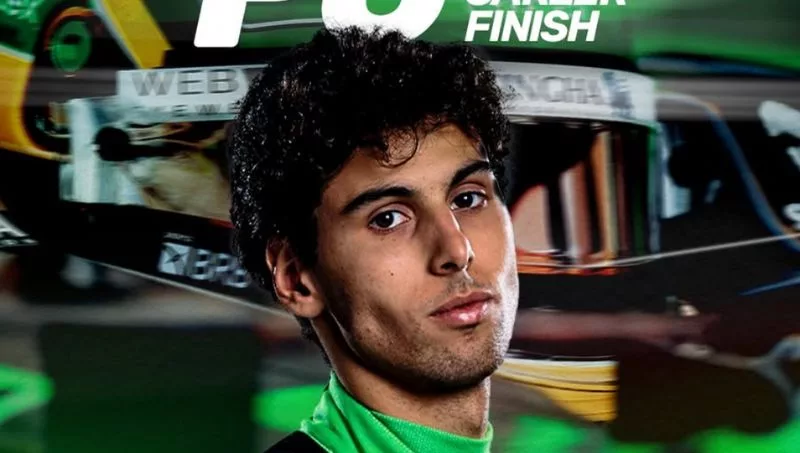

A Landmark for Latin America in F1, Reviving Passion and Opportunities
This achievement not only revives the legacy of legends like Ayrton Senna and Juan Pablo Montoya but also opens a new chapter for motorsport marketing, sponsorships, and the projection of Latin talent on a global stage dominated by Europeans.
Did you know that Bortoleto was confirmed in F1 after the 2024 Brazilian GP, where Franco Colapinto (Argentina) drew over 15,000 fans — though only 9,000 tickets were sold? The buzz among business leaders, media, and fans was electric. Just a week after that race, Liberty Media and Sauber finalized sponsorship deals that brought a new Latin American driver back to F1 — a huge business opportunity for Brazilian brands, the country’s media, and tourism.
-
What does this milestone mean for business, branding, and motorsport culture across LATAM?

Key Lessons from Bortoleto’s Breakthrough & Its Impact
-
Sauber’s Resurgence:
With 51 points in 2025, the Swiss team is surpassing expectations, overtaking rivals like Racing Point, and investing heavily in young talent like Bortoleto. -
High-Profile Praise:
Fernando Alonso called him “the best driver of his generation,” highlighting his consistency and winning mentality. -
Viewership Surge:
The Hungarian GP hit a peak of 15 million viewers across LATAM — a 22% increase over 2024, according to Nielsen. -
Commercial Opportunities:
Bortoleto’s performance is attracting brands like Petrobras and Visa — with sponsorship deals estimated at USD $5 million annually just from these two (Forbes).

1. A Historic Context: The Latin American Dry Spell in F1
The last Latin American on the podium was Felipe Massa in 2008. Since then, European dominance—Hamilton, Verstappen, Leclerc—has sidelined the region. Bortoleto, F2 champion in 2024, signals a strategic comeback, backed by programs like Red Bull LATAM’s Driver Academy.
-
Only seven Latin Americans have won races: Fangio, Senna, Reutemann, and others like Checo Pérez and Prost.
-
In 2025, the grid includes three Latin drivers: Bortoleto (Brazil), Colapinto (Argentina), and Drugo (Mexico — Reserve).
The last Brazilian on the podium was Massa in 2013, and the last in the top six was in 2017.

2. The Winning Mindset: Lessons in Management
Bortoleto blends technique with tactical intelligence. As Sun Tzu said in The Art of War: “Speed without strategy is noise.” His tire management and clean overtakes in Hungary set him apart. Pat Symonds, former technical director of Alonso, states: “He has Senna’s calmness and Prost’s intelligence.”
In 2024, Sauber invested USD $2 million in a VR simulator to help him master complex circuits like Hungaroring — a key factor in his rapid adaptation.
3. Commercial Opportunities: The “Bortoleto Effect”
His breakthrough is reigniting interest from brands in LATAM:
-
Sponsorships: Latin American companies increased their F1 investments by 30% in 2025 (Statista).
-
Sports Tourism: Miami plans to include the Las Américas GP in VIP packages, according to the Greater Miami Convention & Visitors Bureau.
Bortoleto didn’t just break a dry spell — he proved that Latin American talent, combined with strategic management and cutting-edge tech, can compete at the highest level. For Miami, a hub of sports and business, his success is a prime opportunity to attract investments, events, and partnerships—especially given the close economic ties between Brazil and Miami.
As Enzo Ferrari famously said: “F1 is the sport that brings heaven closer to earth.” Today, a Brazilian driver is proving it.

FAQs: Key Questions About This Phenomenon
Why is a 6th place so significant?
In modern F1, with dominant teams like Mercedes and Red Bull, finishing in the points (top 10) is already a success. Achieving it with Sauber (7th in constructors) is extraordinary.
How does Bortoleto compare to other Latin drivers?
His style echoes Emerson Fittipaldi’s (two-time world champion in the 70s), but now with access to cutting-edge 4.0 technology. According to Auto Motor und Sport, he’s “the most promising prospect since Verstappen.”
What’s next for Bortoleto in 2026?
He could be signing with Alpine or Aston Martin, with a current clause valued at USD $15 million, according to ESPN.

Latin Americans in F1: History & Impact
-
From Ayrton Senna’s legendary victories to Nelson Piquet and Emerson Fittipaldi, Brazil has long been a cradle of F1 champions. Yet, recent years have seen Latin American representation wane, mainly due to reduced regional investments and resources.
-
Over the last decade, F1 has dramatically shifted—greater emphasis on data-driven engineering, aerodynamics, and strategic finesse. Talent now depends heavily on science and technology, with teams investing heavily in innovation.
-
Bortoleto’s Hungarian result demonstrates Latin American drivers are adapting to these new demands. The support from academies like Red Bull LATAM, along with strategic investments, is key to this resurgence.

The Regional Impact
Icons like Fernando Alonso and other figures praising Latin talent inspire new generations in LATAM. The success stories of drivers like Sergio Pérez—who’s scored multiple podiums—show that with talent, investment, and strategic backing, the region’s motorsport future remains bright.
A Promising Future for Latin America in F1
Bortoleto’s 6th place isn’t just a stat—it’s a symbol that Latin America can still compete at the highest levels of global motorsport. History teaches us that with the right strategy, investment in talent, and institutional support, Latin drivers can once again dominate the sport’s elite echelon.
Read Smart, Be Smarter!
Infonegocios NETWORK: 4.5 million Anglo-Latinos united by a passion for business.
¡Sé parte y únete para recibir toda la información estratégica y pertenecer a la comunidad de negocios y cultura más grande de todo anglolatina!:
-
¡Únete sin costo!: https://infonegocios.miami/suscribite-al-newsletter

Contact Infonegocios MIAMI:
-
marcelo.maurizio@gmail.com








Tu opinión enriquece este artículo: