
The Analog Counteroffensive in a Digital Universe
-
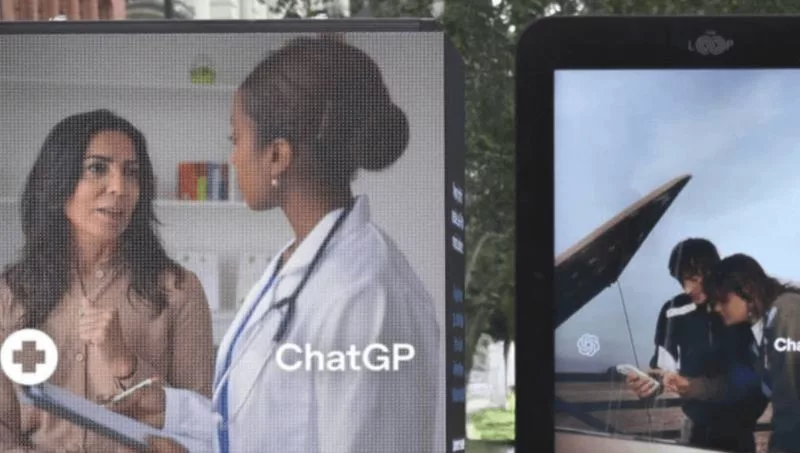
In an irony Marshall McLuhan would have relished, ChatGPT—the very embodiment of the digital revolution—has descended from the computational cloud to inhabit the most primal physical stage of marketing: billboards, bus shelters, and the urban walls of Manchester. This apparent contradiction exposes an inconvenient truth the digital ad industry has tried to downplay for two decades: real human attention isn’t captured by algorithms; it’s won in the visceral arena of shared urban experience.
Havas Lynx’s “Chat GP” campaign is not merely a creative riposte to OpenAI’s ubiquity across the UK adscape. It crystallizes a phenomenon theorized by academics like Scott Galloway and strategists like Byron Sharp—but rarely executed with such audacity: crossing marketing—that hybrid discipline where urban anthropology, neuro‑communication, and brand activism converge to trigger cognitive disruption in public space.

Anatomy of an Intervention: When OOH Becomes a Semiotic Guerrilla
-
Havas Lynx’s strategy operates across multiple planes of meaning at once. By physically intervening on ChatGPT ads with the line “For trusted medical advice, always chat to your GP,” the agency executes what the French semiotician Roland Barthes would call a détournement—the subversion of dominant messages through appropriation and recontextualization.
There are further layers of sophistication here. The linguistic play between “ChatGPT” and “Chat GP” isn’t mere cleverness; it’s applied neurolanguage. Research by cognitive neuroscientist Stanislas Dehaene shows our brains process homophones and visually similar words by activating identical neural networks before semantic differentiation. That split‑second of cognitive confusion creates what attention psychologists call a “deep processing moment”—when, forced to resolve ambiguity, the brain encodes information more intensely into long‑term memory.
The Doctored Truths Report: X‑Ray of an Epistemic Crisis
-
The study underpinning this campaign—Doctored Truths by Havas Lynx—reveals data that should alarm any public‑health professional: 44% of Britons have consulted AIs for medical advice, while the same 44% distrust those very tools. This paradox—mass usage alongside widespread skepticism—defines what sociologist Zygmunt Bauman would term a “liquid modernity in health”: we navigate existential uncertainty with tools we know are deficient, because the alternative—an information vacuum—is psychologically intolerable.
-
Claire Knapp, CEO of Havas Lynx, frames the dilemma with surgical precision: “AI can bring innovation to the sector, but it does not replace medical judgment.” This seemingly obvious point counters a dangerous cultural trend: the democratization of expertise—the phenomenon where access to information is confused with the possession of expert knowledge.
-
Cardiologist Eric Topol, author of Deep Medicine, documents how diagnostic algorithms can outperform individual radiologists at detecting anomalies, yet lack what he calls “contextual intelligence”—the human capacity to integrate symptoms with life histories, unspoken anxieties, and cultural nuances that determine treatment adherence.
A chatbot can list diabetes symptoms; a GP understands why an Argentine patient in Kendall can’t afford insulin—and negotiates viable alternatives.

Out‑of‑Home: The Last Bastion of Unfragmented Attention
-
Choosing OOH as the vehicle for this cultural counteroffensive isn’t arbitrary; it’s strategically astute. While digital ads face ad‑block rates north of 42% (PageFair) and attention windows measured in milliseconds, OOH operates within what marketing neuroscientists call a “sustained passive attention” environment.
-
Cognitive neuroscientist Adam Gazzaley’s research shows our brains process urban environmental stimuli in a state of “relaxed alertness”—receptive but not defensive. Unlike digital ads—perceived as intrusive and a driver of “cognitive fatigue”—OOH integrates into the cityscape as part of the visual ecosystem our brains continuously scan for patterns, threats, and opportunities.

In Manchester—a city of 550,000 with over 2.8 million in the metro area—Havas Lynx’s interventions captured something more valuable than impressions: moments of collective reflection. When hundreds wait for a bus beneath the same subverted message, they co‑create what urban anthropologist William H. Whyte called “spaces of passive socialization”—places where, absent direct interaction, we share cognitive experiences that forge common cultural narratives.
The Rise of the Head of Culture: Architects of Meaning in the Post‑Human Era (if your company—even a tech firm—doesn’t yet have an experienced off‑on, multi‑competency expert, it’s time to hire one)
-
This campaign signals the emergence of a new organizational role that transcends traditional marketing: the Head of Culture—a hybrid professional blending cultural anthropology, media strategy, brand activism, and tech ethics. Not a community manager, not a CMO—an architect of narratives mediating between corporations and collective consciousness.
-
A Head of Culture understands that in hyper‑fragmented markets like Miami—home to 150 nationalities and 80 languages—brand differentiation isn’t achieved through classic demographic targeting but through deep cultural resonance. It’s what brand strategist Marty Neumeier describes in The Brand Gap as the “zag”—when everyone zigs right, you zag left with radical authenticity.
By leading this campaign, Claire Knapp didn’t act as a conventional CEO but as a Head of Culture: she identified a cultural dissonance (mass use of AI for medical advice + generalized distrust), diagnosed its public‑health implications, and orchestrated a response that transcends her client’s immediate commercial interests to serve the broader good. This is what Philip Kotler terms “Marketing 4.0”—where brands evolve from value extractors to creators of social value.
Read Smart, Be Smarter.
Infonegocios Miami—Economic, Cultural, and Business Intelligence with a Global Lens

© 2025 Infonegocios Miami.
Read Smart, Be Smarter!
https://infonegocios.miami/suscribite-al-newsletter
Contact: [email protected]
Infonegocios NETWORK: 4.5 million Anglo-Latinos united by a passion for business.
Join us and stay informed







Tu opinión enriquece este artículo: