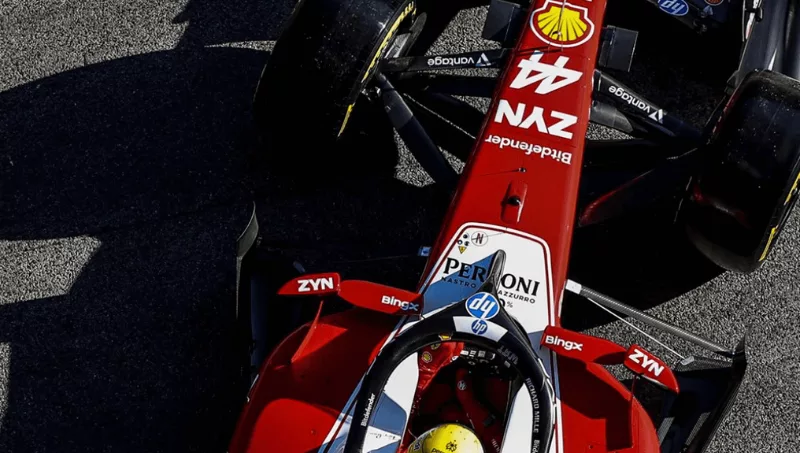

Let’s break it down precisely: F1 isn’t just about speed. It’s a real‑time mash‑up of cutting‑edge engineering, data intelligence, business strategy, and high‑performance psychology. That’s why Silicon Valley, top schools like MIT and Stanford, and consulting giants like McKinsey and Deloitte study the F1 paddock like it’s a live economic lab.
👉 Check out the preview video here:
https://www.instagram.com/reel/DVEO4CaDMPa/

And 2026 is shaping up to be one of the most fascinating experiments in years.
Defending champ Lando Norris with McLaren starts the season in a scenario where the competitive balance could flip fast. According to renowned commentator Andrés Agulla, early signs put Mercedes and Ferrari “a tiny step ahead,” with McLaren and Red Bull right there on the strategy board.
But behind that seemingly simple line lies a complex phenomenon: the invisible engineering war.
Mercedes arrives with what many paddock engineers see as the most efficient power package heading into the season. The German engine doesn’t just deliver power—it optimizes energy consumption and thermal management, two variables that on a semi‑street circuit like Albert Park can decide crucial tenths of a second.

Ferrari, meanwhile, stunned in testing with an aggressive redesign at the rear of the car. In tech terms, this shakes up the “aero balance”—the aerodynamic equilibrium that dictates how the car handles load through fast corners and hard braking. A car with that kind of stability is a perfect match for drivers with a precise, technical style, like Lewis Hamilton.

Red Bull kicks off a new era with Ford power after its historic run with Honda. Changing your power‑unit supplier in F1 is like a company swapping out the entire operating system of its digital infrastructure—everything needs recalibrating.
And McLaren comes in with a classic business‑strategy dilemma: win today or build for tomorrow. The team prioritized closing out 2025 as back‑to‑back champions, which may have slowed development on the new car.
That exact same trade‑off faces tech firms, startups, or investment funds every day.
Albert Park: The Circuit That Tells the Truth
The Australian track is a favorite among technical analysts. At 5.278 km long, with 58 scheduled laps, it mixes fast straights with technical corners that punish any mistake.
Plus, it’s a semi‑street circuit. That means less runoff and a higher chance of incidents.
That’s why many engineers call it the championship’s “psychological test.”
Here, it’s not necessarily the fastest car that wins—it’s the team that best masters the whole system: tires, energy, pit‑stop strategy, and driver composure under pressure.
The current lap record belongs to Charles Leclerc with a 1:19.813, set in 2024.
But more interesting than the time is what the track reveals: which teams truly figured out the new technical balance of the season.
The Colapinto Effect & the New Latin Map in F1
Another focus point for Latin America will be Argentina’s Franco Colapinto, who starts a new season with Alpine.
His presence is more than just individual talent—it’s part of a trend that sports‑marketing analysts have spotted: F1’s strategic expansion into cultural markets with huge passion for motorsport.
Latin America, the United States, and the Middle East are now the sport’s three major growth territories.
And on that map, Miami has become a key player.
From the Miami Grand Prix to Florida’s booming sports‑business ecosystem, F1 is no longer just a European show. It’s a global platform for entertainment, tech, and capital.
What Businesses Can Learn from Formula 1
Maybe the reason universities, tech companies, and governments watch F1 is that the sport packs some of the most crucial strategic lessons of the 21st century.
-
Data is the new fuel.
A modern F1 car generates over a million data points per second during a race. -
Innovation happens under pressure.
In F1, an aerodynamic upgrade can be designed, tested, and deployed in under two weeks. -
Human talent is still the ultimate edge.
No matter how advanced the tech, the final difference is made by a driver making decisions at 300 km/h.
Put simply: Formula 1 is the perfect metaphor for the modern world.
Speed, technology, strategy, uncertainty.
And this weekend, when the lights go out in Melbourne, it won’t just be a race starting.
It’ll be a new chapter in the fastest lab on the planet.
Australian Grand Prix Schedule
(Times in Argentina / Miami – subtract 2 h for Miami)
-
Free Practice 1: Thursday 22:30
-
Free Practice 2: Friday 02:00
-
Free Practice 3: Friday 22:30
-
Qualifying: Saturday 02:00
-
Race: Sunday 01:00
Read Smart, Be Smarter!
https://infonegocios.miami/subscribe-to-newsletter
Contact: [email protected]
Infonegocios NETWORK: 4.5 million Anglo-Latinos united by a passion for business.
Join us and stay informed.
© 2025 Infonegocios Miami.
Infonegocios Miami—Economic, Cultural, and Business Intelligence with a Global Lens










Tu opinión enriquece este artículo: