(High-value strategic read — 4 minutes. Built to be shared and saved.)

The Danish brand dropped an astronomical investment to headline the most viral commercial of the entire World Cup 2026 run-up. A masterclass in branding, creativity, and data intelligence that every serious entrepreneur needs to study.
-
Some ad campaigns sell products. Others create cultural moments.
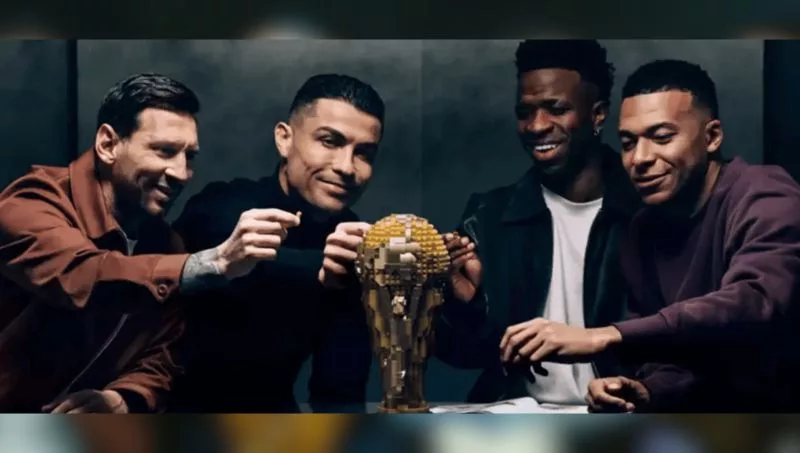
LEGO just owned the second category with a piece that, within hours, became the most talked-about commercial on the planet: Lionel Messi, Cristiano Ronaldo, Kylian Mbappé, and Vinícius Júnior — sitting around a spinning table, competing to build a World Cup trophy out of blocks.
What Nike and Adidas, with their colossal budgets and decades of dominance in sports sponsorship, never pulled off — a toy company just made it happen.
The question isn't just how they did it. The real question is: how much did it cost, and what's the business lesson hiding inside?
Check the spectacular spot right here: (🎬 Watch the Ad )
The Numbers That Stop You Cold
Before we talk creativity, we need to talk investment — because the figures hit just as hard as the commercial itself.
According to data published by Forbes, the fees paid to each player exclusively for distributing the content on their personal social media profiles broke down like this:
|
Player |
Fee per Instagram Post |
|
Cristiano Ronaldo |
USD $3,430,000 |
|
Lionel Messi |
USD $2,590,000 |
|
Kylian Mbappé |
USD $852,000 |
|
Vinícius Júnior |
USD $325,000 |
|
Total — Distribution Only |
USD $7,197,000 |
And that's just the tip of the iceberg. These figures cover only the social media posting fees. The total campaign cost — factoring in cinematic production, image rights, global production logistics, and the overarching FIFA partnership agreement — goes significantly beyond that number, according to sports marketing analysts specializing in this space.

"We're talking about an investment that, in organic distribution alone, exceeds the entire annual marketing budget of most mid-sized companies across Latin America," notes a marketing strategist with deep experience in global sports campaigns. "But when you analyze the return, the equation looks completely different."
The Return That Justifies Every Single Dollar
The engagement numbers tell a very different story from the spend.
The joint post shared between Cristiano, Mbappé, Vinícius, and the FIFA account surpassed 13 million likes. Messi, posting solo, clocked nearly 19 million interactions — and in just 30 minutes had already stacked half a million reactions.
To put that in perspective: no traditional advertising campaign, no matter how massive the media buy, can guarantee that level of organic penetration in that kind of timeframe. LEGO didn't just purchase visibility — they purchased cultural relevance at a moment of peak global attention, just weeks before the kickoff of World Cup 2026.
"The cost per real impact — when you divide the total investment by the effective reach generated — makes this one of the most efficient campaigns in recent sports marketing history," the specialist explains. "The entire world talked about LEGO for days without the brand spending a single additional cent on traditional media."
The Narrative That Changes Everything
But beyond the numbers, what makes this campaign genuinely extraordinary is its creative concept.
The four greatest players on the planet try to place their own figure at the top of the trophy. None of them succeeds. A kid walks in, drops the final piece into place, and takes the glory.
The message is as simple as it is powerful: soccer is a universal game, and anyone can be part of it. In under two minutes, LEGO took the trophy away from the superstars and handed it back to the fans. That's not just smart advertising — that's emotional brand architecture executed with surgical precision.
"What LEGO achieved here is the textbook definition of a campaign that connects with multiple audiences simultaneously," analyzes one of the sector's leading sports marketing strategists. "It speaks to kids who play with blocks, to adult collectors, to soccer fans across every generation, and to Messi and Cristiano devotees in equal measure. There is not a single segment of the global audience that gets left out."

The AI Controversy — And the Brand's Clarification
The commercial also sparked an unexpected debate. Behind-the-scenes footage leaked online — footage that didn't show all four players together — and immediately ignited speculation about whether artificial intelligence had been used to recreate their likenesses.
LEGO moved fast to shut it down, clarifying that body doubles were used for the shoot — a completely standard practice in productions of this scale, where coordinating the schedules of four of the most in-demand and closely managed athletes on Earth is, realistically, next to impossible.
But beyond the controversy itself, the episode added a critical ingredient to the virality formula: the conversation. Every speculation, every debate, every clarifying article became additional fuel — keeping the campaign at the center of the digital ecosystem for days longer than a clean, controversy-free rollout ever would have.

The Business Strategy Behind the Commercial
The spot isn't a standalone event — it's the spearhead of a larger commercial strategy.
LEGO signed an official agreement with FIFA and launched a global collection tied to World Cup 2026 that includes collectible sets inspired by all four players, with price points ranging from USD $25 to USD $160, plus a full-size replica of the trophy unveiled in late 2025.
Each figure is designed as a minifigure with custom bases, hidden details, and references to iconic moments from their respective careers. The play combines three markets in one: pop culture, elite sport, and premium collectibles. A consumption trilogy with very few real precedents in the toy industry.
The Business Lesson
What LEGO executed here is a straight-up applied business strategy manual for high-impact marketing.
First — they identified a one-of-a-kind window of opportunity: World Cup 2026, the most-watched event on the planet, hosted on North American soil for the first time in decades.
Second — they bet on the scarcest asset in the entire sports ecosystem: getting the four most influential figures in global soccer into a single piece of content.
Third — they built a message that doesn't compete with the sport. It amplifies it.
The result isn't just a viral commercial. It's a reaffirmation that brands investing in genuine creativity — backed by emotionally resonant narratives and tier-one cultural assets — generate returns that no traditional paid media campaign can replicate.
In the run-up to World Cup 2026, LEGO didn't just sell blocks.
They built something far harder to buy: global relevance. 🧱🌍🏆
Read Smart, Be Smarter.
🔗 Subscribe to our Newsletter 📩 Contact: [email protected]
Infonegocios NETWORK — 4.5 million Anglo-Latinos united by a passion for business. Join us and stay sharp.

© 2026 Infonegocios Miami Economic, Cultural & Business Intelligence with a Global Lens www.Infonegocios.Miami







Tu opinión enriquece este artículo: