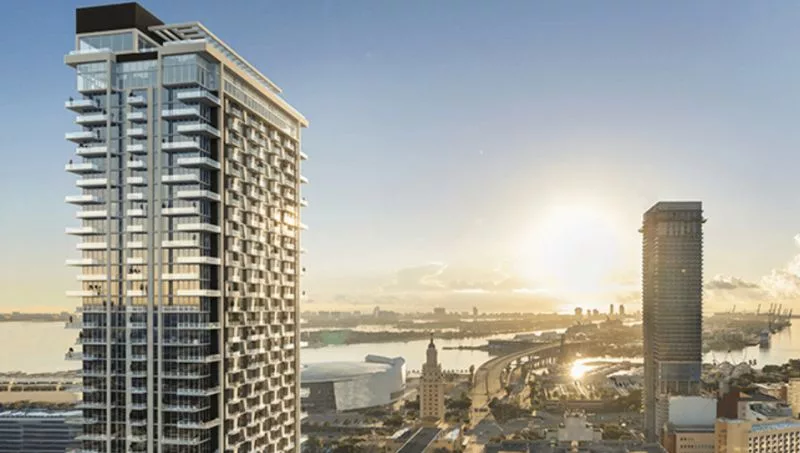

The Collapse of the Myth: When the Numbers Kill the Narrative
For decades, Miami lived in the Latin American imagination as an impenetrable fortress: a playground reserved for ultra‑high‑net‑worth individuals, a kind of financial theme park where the price of admission was measured in millions and access was limited to last names that show up in Forbes.
That storyline, repeated so often it hardened into “common truth,” has just been demolished by something far more powerful than perception: hard, inescapable data.
-
ISG World’s Q3 2025 Miami Report is not just another quarterly market update; it is effectively the death certificate of an old worldview. The numbers in this report amount to what economist Thomas Kuhn would call a “paradigm shift”: a structural reset so deep that it forces us to completely rewire how we think about cross‑border real estate investment.
The New Frontier for Latin American Capital: Where Math Beats Myth
The transformation is measurable and strikingly clear: financing of up to 70% of property value available without U.S. residency. Ticket sizes starting at USD $300,000 — comparable to prime districts in Mexico City, Lima, or Bogotá. Mortgage rates at 6.18%, the lowest level in three years. And the knockout blow to the “Miami is overbuilt” cliché: over 19,000 closed transactions between January and September 2025, outpacing the prior year in a market supposedly “oversupplied.”
-
These are not marketing talking points; they are forensic evidence of a structural opportunity that most Latin American investors have not yet fully processed.
The Anatomy of Access: Decoding the New Financial Architecture
The truly disruptive element is not that Miami is attractive — it always has been — but that U.S. financial institutions have fundamentally reframed their risk appetite toward foreign capital. This is not philanthropy; it is strategic market positioning by banks that understand an unavoidable demographic and economic reality.

The 70/30 Financing Model: Intelligent Leverage by Design
The fact that U.S. lenders are now offering up to 70% financing to non‑resident foreign buyers is a historic anomaly that deserves real scrutiny. Traditionally, this type of credit required:
-
Permanent residency or citizenship
-
At least 2 years of U.S. credit history
-
Down payments in the 40–50% range
-
Punitive rates, 200–300 basis points over those paid by residents
The new lending framework removes these choke points through what I call a “collateral‑first underwriting” approach: the value of the asset and verifiable repayment capacity matter more than the buyer’s passport.
-
This signals institutional maturity: banks have recognized that well‑documented Latin American investors often present a lower default risk than many local buyers stretched to the limit.
-
The math is revealing: with a USD $90,000 down payment (30%), an investor can control a USD $300,000 asset in submarkets such as Edgewater or Aventura. At a 6.18% rate, the approximate monthly mortgage payment is USD $1,285. If that unit rents for around USD $2,200 per month (a conservative 8.8% annual yield), net positive cash flow runs at about USD $915 per month after debt service.
-
This is positive leverage in its purest form: your tenant services your mortgage while you build equity in dollars, under a stable legal framework, in a market with a historical appreciation rate near 5.2% annually.

Brickell and Downtown: The Verticalization of Opportunity
The ISG World report highlights five primary submarkets: Brickell, Downtown, Edgewater, Miami Beach, and Aventura. But Brickell and Downtown warrant a standalone look because they represent what I call “urban density premium zones”: pockets where the concentration of financial, corporate, and lifestyle infrastructure generates network effects that compound real estate value.
Brickell: The Tropical Manhattan
-
Brickell is not just a neighborhood; it’s effectively the financial capital of Latin America operating on U.S. soil. Over 150 international banks, a critical mass of global family offices, a deep base of high‑earning professionals, and frictionless access to Miami International Airport combine into a singular ecosystem.
-
The skyline build‑out is ongoing: roughly 30,000 units in the pre‑construction pipeline, 7,600 currently under active development, and 52% of that inventory already pre‑sold. That last data point is crucial: more than half the pipeline is spoken for before delivery, a clear signal of structural — not speculative — demand.
-
Average pricing for next‑generation product in Brickell ranges from USD $800 to $1,200 per square foot, depending on amenities and view corridors. For context: comparable projects in Polanco (Mexico City) or Zona T (Bogotá) can trade in the USD $600–$900 per square foot band — but in volatile local currencies and under less predictable regulatory regimes.
Downtown Miami: The Post‑Pandemic Reinvention
-
Downtown has undergone a rapid‑fire metamorphosis since 2020. Miami Worldcenter — a USD $4 billion mixed‑use development — now anchors the district with a blend of retail, residential, hospitality, and cultural space. The Brightline high‑speed rail, connecting Miami with Orlando and Tampa, has repositioned Downtown as a true regional mobility hub.
-
The demographic profile is the tell: 68% of recent buyers in Downtown are under 45 — professionals in tech, finance, and the creative economy. This stands in sharp contrast to Miami Beach, where the average buyer skews 55+ and above, and it underscores a youth‑driven urbanization wave: younger cohorts prioritizing walkability, amenity‑rich density, and an authentic urban experience over the traditional suburban play.
Macro Foundations: Why Numbers Don’t Lie
Florida Demography: 1,350 New Residents Per Day
This seemingly simple data point is the linchpin of the entire investment thesis. Florida absorbs roughly 493,000 new residents annually. For context:
-
Uruguay’s total population: 3.4 million
-
Florida adds the equivalent of 14.5% of Uruguay’s population every year
This migration is not random; it is selective geographic arbitrage: high‑income professionals relocating from high‑tax states (New York, California, Illinois) to Florida, which has no state income tax. It’s a massive transfer of human and financial capital southward.
Each new resident needs housing. Supply is robust (30k units in the pipeline) but insufficient to absorb ongoing demand. Economists would call this a “structural supply deficit”: a persistent gap between supply and demand that supports price appreciation regardless of short‑term cycles.
The Post‑Frenzy Normalization: From 120 to 240 Days on Market
-
The average time to sale doubling from 120 days (2024) to 240 days (2025) is not weakness; it’s market health. The 2021‑2023 period was a historical anomaly: homes selling in 48 hours above asking, bidding wars, institutional FOMO. That was unsustainable and potentially dangerous.
-
Current normalization indicates functional price discovery: buyers have time for due diligence, sellers align expectations with reality, and transactions occur on fundamentals rather than panic. As Warren Buffett says: “When the tide goes out, you learn who’s been swimming naked.” The Miami market in 2025 has its beachwear on.
Interest Rates: The Downcycle Has Just Begun
-
The Federal Reserve began cutting rates in September 2024, with projected reductions to roughly 3.5–4% by late 2026. Mortgage rates, which track Treasuries with a 60–90 day lag, have fallen from 7.8% in October 2023 to about 6.18% now.
-
Each percentage point of rate reduction roughly expands purchasing power by about 10%. If rates fall to 5% (a conservative 2026 scenario), a buyer who today qualifies for $300k would qualify for about $330k income‑dependent, all else equal. This is demand expansion without a change in fundamentals, pushing prices higher.
The World Cup 2026 and G20 Catalysts
-
Miami will host World Cup matches, including a crucial third place game. The G20 2026 will be held here as well. These events are not mere publicity; they are infrastructure‑forcing functions: accelerators of public investment in transit, public spaces, security, and connectivity.
-
Historically, host cities of mega‑events see average real estate appreciation of 12–18% in the 24 months prior and 6–9% in the 12 months after, per Oxford Economics. More importantly than the speculative bump is the sustained enhancement of global profile: Miami post‑2026 will be recognized unequivocally as a Tier 1 global city, not just a tourist destination.
Gálvez & PFS Realty: The Voice of Experience in a Noisy Market
-
Gustavo Gálvez, CEO of PFS Realty Group and with more than two decades advising Latin American investors, offers a crucial perspective: “For years the market was portrayed as exclusive. Today access is broader, financing is available, and decisions should be based on verifiable information, not impressions. Making wealth decisions requires rigor and a long‑term view.”
-
This isn’t sales rhetoric; it’s epistemic responsibility in an industry crowded with emotional narratives and manufactured FOMO. Gálvez outlines fundamental principles: wealth decisions require fundamentals, not feelings. Firms like PFS Realty operate as knowledge bridges—translating U.S. regulatory, tax, and operational complexity for Latin American investors who, though sophisticated in their home markets, face information frictions abroad.
The Latin American Context: Why Diversification Is an Existential Imperative
The Miami thesis does not exist in a vacuum; it sits within a context of structural volatility in Latin America:
-
Brazil: Selic at 11.25%, real depreciating ~14% vs USD in 2024
-
Mexico: Peso down ~18% vs USD in 2024, regulatory energy uncertainty
-
Peru: Political instability with 6 presidents in 7 years, Peruvian sol volatile
-
Chile: Pending constitutional reforms creating business uncertainty
-
Colombia: Tax reform affecting investment, peso down ~21% vs USD in 2024
In this context, Miami isn’t a speculative punt; it’s strategic hedging: tail‑risk protection in a litigious, currency‑constrained origin jurisdiction. As Nassim Taleb explains in Antifragile, geographic diversification across hard assets, strong currency, and predictable legal systems is an asymmetric bet—downside is limited (modest or flat appreciation) while upside is potentially unlimited (capital preservation in local crises).

-
Model an investment to materialize the abstract:
Investor Profile: Peruvian professional, 40, net worth USD 500k, seeking geographic diversification and passive income.
Target Property: 1‑bedroom condo + den, Edgewater, 750 sq ft, listing price USD 315,000
Financing Structure:
-
Down payment 30%: USD 94,500
-
Financing 70%: USD 220,500
-
Rate 6.18%, 30 years: monthly payment USD 1,346
-
HOA: USD 380/month
-
Property tax: USD 395/month (1.5% annual)
-
Insurance: USD 185/month
-
Total monthly expenses: USD 2,306
Income Projection:
-
Rent: USD 2,800/month (gross yield 10.67%)
-
Management fee (10%): USD 280
-
Net rent: USD 2,520
Monthly Cash Flow: USD 2,520 − USD 2,306 = USD 214 positive
Return Analysis:
-
Cash‑on‑cash return: (USD 214 × 12) / USD 94,500 = 2.72% annually
-
Conservatively, 4% annual appreciation on USD 315k = USD 12,600
-
Principal amortization: approx USD 3,200 first year
-
Year 1 total return: USD 2,568 (cash) + USD 12,600 (appreciation) + USD 3,200 (equity) = USD 18,368
-
ROI on invested capital: USD 18,368 / USD 94,500 = 19.44%
Additionally:
-
FX hedge: USD‑denominated asset
-
Jurisdictional diversification: outside Latin American political/legal systems
-
Liquidity: deep market allows relatively quick exit
-
Personal optionality: potential for personal use or relocation
This isn’t “get rich quick.” It’s wealth preservation with moderate growth—tangible asset in a stable economy, generating positive cash flow from day one.
The Omitted Risks: A Full Analysis Demands Honesty
Integrity requires naming risks:
-
Hurricanes and climate: Florida is hurricane‑prone. Insurance is costly and mandatory. Well‑built properties (post‑2002 code) withstand well, but risk exists.
-
Insurance market: Property insurance in Florida is consolidating; premiums up 15–25% annually. This affects operating costs.
-
Property tax creep: Florida has no state income tax, but property taxes can rise with valuations. Homestead exemptions do not apply to nonresidents.
-
HOA special assessments: Buildings may levy extraordinary assessments for major repairs. Diligence on reserves and deferred maintenance is critical.
-
Regulatory change: U.S. immigration policies can shift affecting foreign capital flows.
-
Real estate cycle: Fundamentals are solid, but the market is cyclical. Buying at the cycle peak can yield years of flat appreciation.
These risks are manageable with proper due diligence, not eliminable. Smart decisions incorporate risk in the model, not ignore it.
Strategic Imperative: Timing vs. Time in Market
-
Latin American investors often stall waiting for the “perfect moment”: “Have prices fallen enough?” “What if rates fall further?” “Isn’t it still too expensive?” These questions reveal a market‑timing mindset—an approach that has historically underperformed.
Buffett’s maxim applies: “The stock market is a device for transferring money from the impatient to the patient.” The same holds for real estate. The data are clear:
-
Structural demand is robust (1,350 residents per day)
-
Supply is insufficient to absorb long‑term demand
-
Rates are in a downward cycle
-
Financing is accessible
-
Fundamentals are solid
Time in market beats timing. Buy today with a 10+ year horizon in a fundamentals‑driven zone, and you’re statistically better off than waiting for a bottom that may never come or that you may not recognize when it arrives.
Conclusion: The Open Window, But Not Forever
-
Miami in 2025 represents a rare alignment of factors: unprecedented access to financing, robust demand fundamentals, a favorable rate cycle, and prices that normalized after the surge. This alignment isn’t permanent.
-
When rates drop to 5% (likely 2026), purchasing power will expand 15–20%, pressuring prices. When the World Cup/G20 elevate Miami’s global profile, institutional capital will enter aggressively. As developers absorb current inventory, new supply takes 24–36 months to reach market (typical construction lag), creating a supply gap.
-
The window is open today. Latin American investors who act with diligent research, competent advisory, and a long‑term view will access opportunities that, in a 2030 hindsight, will look obvious.
Those who wait for absolute certainty — which never exists in investing — will stand on the sidelines while others build wealth in dollars, in tangible assets, in stable jurisdictions.
As Gálvez puts it: wealth decisions require rigor, not impressions. The numbers are on the table. The question isn’t whether Miami is an opportunity. The question is: are you prepared to act when the data are clear?
Mathematics defeats myths. Fundamentals trump fear. And informed action beats analysis paralysis.
Miami isn’t waiting. The question is: will you wait?
If you’d like, I can tailor this to be even more Miami-specific (e.g., a circulated exec note or elevator-pitch style) or adjust the level of formality.
Read Smart, Be Smarter!
Infonegocios Miami: a publication written by the Anglolatina business community.
Follow for more analysis: @InfonegociosMiami
https://infonegocios.miami/suscribite-al-newsletter
Contact: [email protected]
Infonegocios NETWORK: 4.5 million Anglo‑Latinos united by a passion for business.
Join us and stay informed.
Infonegocios Miami—Economic, Cultural, and Business Intelligence with a Global Lens
Follow for more analysis: @InfonegociosMiami
© 2025 Infonegocios Miami.











Tu opinión enriquece este artículo: