

-
How many times have you resisted listening to your strategy team? How many times have you left unread the book someone gifted you about the Era of the Instant?
-
How often have you denied that we live in an age of hyper‑competition and market oversaturation where relevance and value creation are paramount?
-
How often have you said you had no time to plan or read high‑value articles? How often have you demanded readiness from your team while allocating neither time nor resources to train strategic thinking?
The emergent property of this system is Readiness, represented in the figure below (Levy, A., 2017, “Readiness: The Era of the Instant: vulnerability or corporate collapse when it’s increasingly late earlier,” EDICON, Buenos Aires).
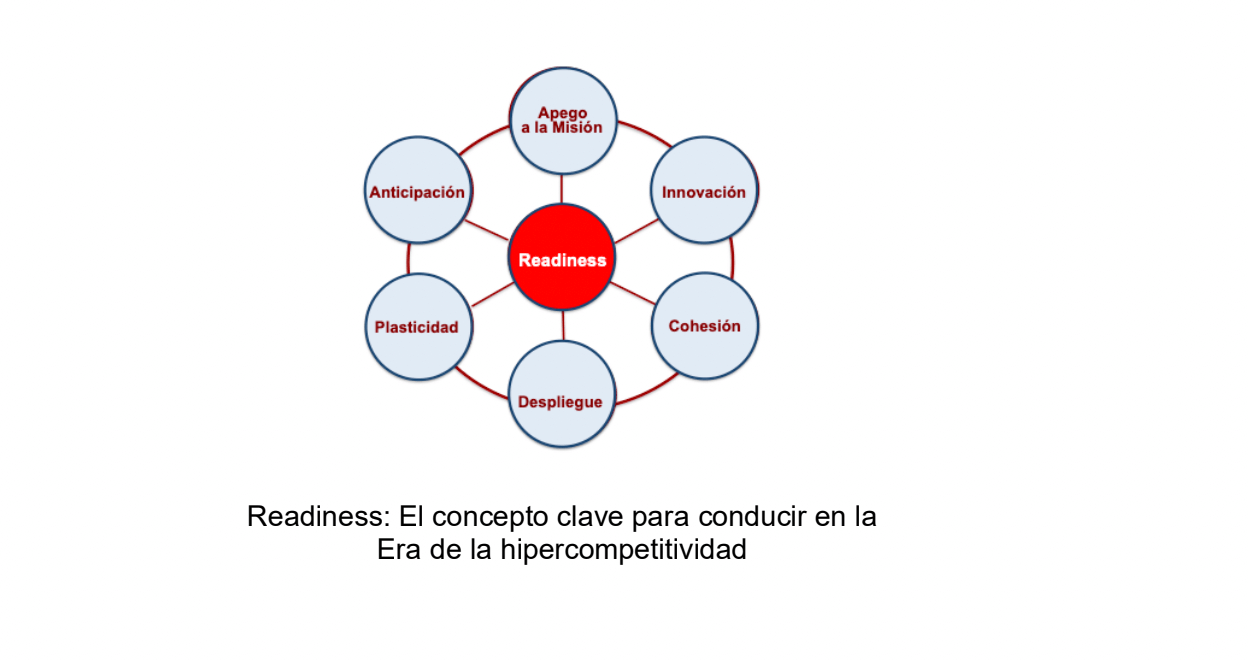
The emergent concept is Readiness (Levy, A., 2017). The six core elements of Readiness:
1. Attachment to Mission
We must distinguish two complementary perspectives on Mission.
-
The first pertains to the organization’s Mission as Corporate Strategy or Portfolio Strategy: the decision of which businesses to invest resources in to achieve the Ultimate Purpose or Ontological Purpose—creating sustainable value while accepting an acceptable level of risk. This is the strategy across all businesses in which a company operates and is critical for holdings or conglomerates.
-
The Ultimate Purpose is the “What for” (what for), not to be confused with the “Why.” The “What for” is a purpose, an objective, an aspiration; the “Why” is a cause, motive, or reason. The “What for” looks to the future; the “Why” refers to the past. In a running company, along the means‑to‑ends chain, there is no terminal point unless the company closes. A “What for” can continue into an “In order to,” which becomes the “What” for another “What for,” and so on.
-
Importantly, “creating economic value” is not merely an objective: it is the company’s raison d’être. It is non‑optional. If you discard it, you are no longer a company in the strict sense. Thus, it is an ontological constraint.
-
The second perspective concerns Competitive Strategy at the business level and closely mirrors the military notion of Mission. In military terms we distinguish, at minimum, three levels in the means‑to‑ends chain: the What (immediate effect), the What for (subsequent effect) and the In order to (Ultimate Purpose). Example: “We must seize hill A‑32/7 (What) to prevent the enemy from taking route #G57, which secures twenty kilometers of coastline (What for), in order to protect our fleet’s passage from west to east (In order to).”
-
From this second perspective we describe two command models:
-
 Command by Control: the traditional vertical issuance of orders from commander to the rank and file.
-
 Command by Mission: all teams fully understand the commander’s intent yet have tactical freedom—plasticity and empowerment—to decide, in the moment, how best to achieve that intent.
-
These are high‑demand, high‑performance teams (often deep‑strike units). Increasingly, corporations are adopting this command‑by‑mission approach.
2. Anticipation
Anticipation is the capacity to foresee plausible future scenarios in which the Mission must be achieved. Given rising volatility, uncertainty, complexity, ambiguity and friction (competitive intensity), extrapolating yesterday’s facts is progressively less useful. Projections based on historical data carry high error risk. Forecasts give way to foresight; budgets rest on assumptions. The central question becomes: what will the competitive arena look like — and how soon will I be able to compete or risk extinction?

3. Innovation
-
We must distinguish incremental innovation (e.g., a redesigned TV cabinet or improved electronics), radical innovation (e.g., SmartTV) and disruptive innovation (e.g., watching television via smartphone over the internet).
-
Disruptive innovation typically entails wholesale business‑model changes: new suppliers, channels, competitors, substitutes, complements and even different end customers.
-
Also differentiate invention (new resource configurations to create products) from discovery (emerging market trends).
-
Innovation demands five levels of learning:
Learn: improve mission performance.
Learn to learn: develop the capacity to change the Mission to a more appropriate one.
Learn to unlearn: alter mental maps and challenge paradigms frozen by past successes that may cause future failures.
-
In an era of fleeting perceived advantages, innovation is not merely an option — it is the only pathway. At its apex, innovation must mutate into reinvention (what we call Changegineering), adding two further levels: learn to relearn, and learn new ways of learning.
4. Plasticity
-
We separate flexibility from plasticity. Flexibility is the resilience to return to a prior state after disturbance: squeeze a tennis ball, release it, and it returns to its original form. Plasticity, by contrast, is a transformative change: squeeze the ball, release it, and it assumes a better form for its goals.
-
The tennis‑ball metaphor illustrates a high‑performance team’s capacity for transformation. Flexibility equals change; plasticity equals transformation.
-
The highest transformation—third level—we call “Freedom of Action,” the capacity for maneuver and mobility. Think chess: checkmate eliminates the opponent’s freedom of action.
5. Cohesion
We distinguish “consensus” from “cohesion.” While the dictionary may conflate them, consensus implies everyone thinks the same—if everyone does, perhaps no one is thinking. Cohesion is a group’s ability to dissent and debate—even heatedly—and yet, when a decision is made, to adopt it as their own, including those who opposed it. We call this capacity to “agree in dissent” the Lilmod factor.
6. Deployment
-
Deployment is the disposition and organization of all resources across the Theater of Operations or Competitive Arena during the phases of executing the Mission. The military analogy is useful, as firms increasingly face the same need to avoid rigidity and strategic‑operational contractures—an issue not only for large corporations but frequently for SMEs, which can suffer severe paralysis.
-
Deployment involves the physical movement of personnel and units from base locations to designated theatres to fulfill mission obligations.
-
A revealing corporate lesson comes from the post‑9/11 shift in U.S. force posture. Prior to 2001, the U.S. Army organized for large‑scale deployments—mechanized divisions of 15,000+ soldiers—requiring lengthy, complex mobilization. The Marines traditionally provided rapid response. The Army restructured into Brigade Combat Teams (BCTs) of a few thousand soldiers, supported by Brigade Support Battalions (BSBs). By 2007 the Army comprised 42 BCTs and 75 BSBs. This pivot to smaller, more agile formations materially improved deployment speed.
In sum, combat leadership means units, ships, aircraft, weapon systems and other military technologies performing in operations consistent with their design purpose, employing resources and trained personnel in preparation for combat.
Editorial note
This high‑value content is an honor for Infonegocios Miami. We thank Alberto Schuster, the distinguished Beyond community, and Professor Dr. Alberto Levy for making it possible.
About the author
-
Alberto Levy is founder, CEO and Chief Customer Experience Officer of LEVY ASSOCIATES — Dinámica Empresarial, a firm specialized in strategy execution.
-
He directs CEADE (Center for Advanced Studies in Business Dynamics) at the University of Buenos Aires. He holds degrees in Business Administration and Public Accounting, a PhD and postdoctorate in Economic Sciences from the University of Buenos Aires, with postgraduate work at Harvard Business School.
-
He also holds a Master’s in Cognitive Psychology, a PhD and postdoctoral studies in Psychology from the University of Buenos Aires with postgraduate work at the Mental Research Institute (Palo Alto, CA).
-
He is an Advanced Leadership Master Consultant (Institute for Organizational Development, Israel), a Certified Project Management Professional (PMI, USA), and Professor Emeritus at the University of Buenos Aires.
© 2025 Infonegocios Miami.
Read Smart, Be Smarter!
https://infonegocios.miami/suscribite-al-newsletter
Infonegocios NETWORK: 4.5 million Anglo-Latinos united by a passion for business.
Join us and stay informed:
Contact Infonegocios MIAMI:
-
marcelo.maurizio@gmail.com












Tu opinión enriquece este artículo: