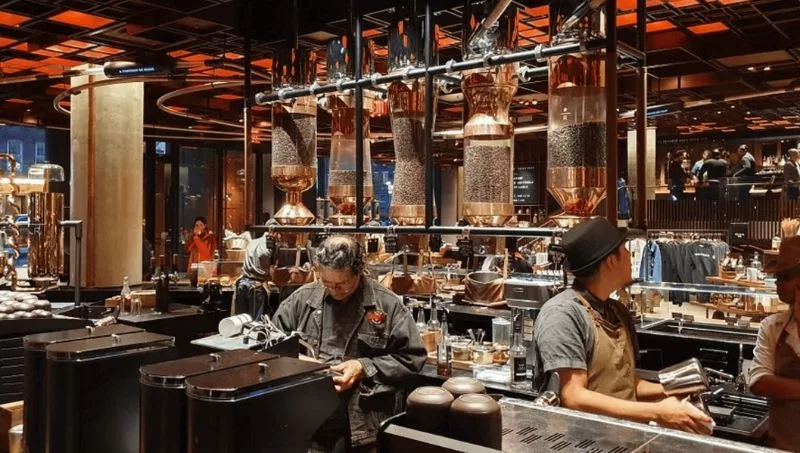

This isn’t merely a market difference. It’s the perfect diagnostic of the epochal shift we’re living through: the chasm between brands that manage and brands that inhabit.
The Diagnosis That “Industry Press” Won’t Publish Because It Isn’t Politically Correct: Corporate Schizophrenia
-
Brian Johnson isn’t facing a restructuring; he’s facing cultural desynchronization. The 85% drop in profits in the U.S. isn’t a purely accounting figure. It’s the symptom of a brand that, between 2017 and 2023, made the costliest generational mistake of the century: believing that digitalization alone could replace physical ritual.
-
A misstep similar to Nike’s, which Adidas seized upon, doing the opposite and anticipating the return of trade marketing, sponsorships, and 90s activations, plus the 2030 phydigital experiential expansion.
-
Starbucks in the U.S. turned into a logistics-efficiency machine: app, drive-thru, products. But it killed its own archetype: the “third place.” Not the coffee, but the sacred pause—the liminal space between home and office. Meanwhile, Alsea in Mexico did the opposite: it didn’t just sell coffee; it cultivated micro-moments of belonging.
-
Today that space is no longer just a space for the U.S. market, because in places like the U.S., Argentina, Australia, the competition (big and small) offers it far better.
What It Reveals About Retail 2026
-
The uncomfortable truth: Mexico is a stable-implementation market that needs modern Starbucks, which, in turn, is at a stage of thematic-experience evolution far below the U.S.—and even more so below Brazil, Argentina, not to mention markets like Miami, New York, Los Angeles, or Dubai.
-
Mexico contributes 39% of Alsea’s revenue not because it’s “cheap,” but because it understood something Seattle forgot: retail today is a cultural service, not a transaction. The 76 openings planned for 2026 aren’t geographic expansion; they are soft invasions of thematic universes.
-
Yet Argentina—after decades of economic drift—now looks to reclaim splendor, and for Alsea, Starbucks or Burger King profitability remains elusive. They should rethink their business model toward new high-value, thematic experiences that are playful, emotional, experiential, and co-created with brands and personalities. Starbucks today in the U.S. would need to reinvent every store, not just with innovative architecture, but with thematic experiences, brand museology, drastically expanding the boutique, making each location a truly special place, and abandoning the “non-place” strategy. Lean into co-creation and collaboration with other brands, with gaming franchises, with Formula 1, with films and series, with fashion houses, with toys—the focus should be on monetizing the operation.

-
What makes sense from a century-old perspective may not today. The path forward is not merely improvement; it’s reversion to a 1990s service culture of hospitality and care, while expanding culture into multi-experiential (phydigital) and multi-category offerings, which implies “reinvesting heavily and restructuring simultaneously.” (This isn’t happening, or isn’t possible, right now.)
-
The market nuance is hard to grasp, but the U.S. market is clamoring for “brand theme parks,” urban jungles with 2030-grade technology mixes, and unique places where new worlds combine—Starbucks with Star Wars, for example—and marketing on the scale of F1, LVMH. This is healthy, far from utopian (and it’s happening), because otherwise the market would stagnate and Asia would flood with mass-market cafés and products—strong performance, but low experience and creativity (as in other categories).
-
In contrast, Mexico longs for a new Starbucks, and that suffices for now. In the U.S., the moment may be different.

The Core Disruption:
-
Mexico operates in “experience investment” mode. The U.S. operates in “financially pragmatic survival” mode. Two opposite metabolism within the same corporate body. The market—an intangible entity—feels it. The energy of a store opening with a fresh narrative versus one closing with an old balance sheet is palpable at a cellular level.
The Energy Fork
-
Starbucks doesn’t live two financial realities. It lives two states of corporate consciousness. Mexico represents investment in the experiential future. The U.S. represents restructuring of the transactional past. This paradox is the industry’s mirror: you can be the brand the market demands (universal, thematic, generous, collaborative) or the brand your financials force you to be (efficient, reductive, defensive).
In 2026, the question isn’t “what do you sell?” It’s “what energy does your store radiate?” Mexico understood it. The U.S. has time to remember it. And your brand, which side of the paradox are you on?
Historical Lesson: When Efficiency Destroys Mythology
-
Recall: Howard Schultz didn’t found a coffee shop; he built a secular cathedral of encounter. In the 90s, Starbucks was pure brand generosity: sofas, curated music, names on cups. Then the obsession with EPS turned it into a Frappuccino factory. The mistake wasn’t growth; it was confusing scale with soul.
Nike made the same misstep: prioritizing dropship over community-store experience. Both brands learned late that Generation Z doesn’t buy products; it adopts tribes. And tribes need physical territories to enact their rituals.
The 15 Actionable Mandates (To Avoid Being the U.S. Starbucks in Your Industry)
-
Your store isn’t a point of sale; it’s a brand dojo. A space where a philosophy is taught and lived.
-
Create unique arrival rituals. Scent, the barista’s first words, the lighting— choreograph them.
-
Introduce at least one local/micro-thematic collaboration per quarter. With a baker, a street artist, a neighborhood clothing brand.
-
Train staff as “guardians of the brand culture,” not cashiers. Their role is to weave community.
-
Design at least one “Instagrammable corner” per store that tells a visual story, not just showcases product.
-
Label spaces by “emotional states” (“Disconnect Corner,” “Collaboration Tables,” “Urban Observer Balcony”).
-
Create exclusive “product-ritual” offerings for in-store consumption only.
-
Do “phygital activations”: one in-store event amplified digitally, yet tactile at its core.
-
Your music is not ambient; it’s emotional curatorship. It should shift with time and customer flow.
-
Offer “context services,” not just products. Pour-over workshops, barista talks, reading nights.
-
Develop an architecture of generosity. Free workspaces, free infused water, visible charging stations.
-
Create a “neighborhood ambassadors” program. Frequent customers who organize micro-events in your space.
-
Measure success with “experiential density” metrics: average dwell time, observed social interactions, organically generated on-site content.
-
Design immersive seasonal capsules. Don’t just update decor; rewrite the space’s entire narrative for a limited period.
-
Hire a “Head of Local Culture.” Their job is to map neighborhood rituals, codes, and myths and translate them into the experience.

The Future Played in the Basement (Or the Terrace)
The 2026 World Cup isn’t a sales chance for Starbucks Mexico; it’s the perfect excuse for a total mutation. Imagine stores turned into broadcasting hubs, with country-themed coffee bars, global-Soundtrack DJ sets. That’s not marketing; it’s cultural geopolitics in café form.
-
Meanwhile, in the U.S., closing 500 stores is the pruning necessary for a rebirth. But the rebirth will only come if they understand they don’t need more apps, but more mythology. They need to reconnect with their founding archetype: be the modern agora, the tech-enabled public square where ideas are negotiated, not just lattes purchased.
If you’d like, I can tailor this for a specific publication format (press release, executive briefing, LinkedIn article) and adjust length and tone to fit.
Read Smart, Be Smarter.
Infonegocios Miami—Economic, Cultural, and Business Intelligence with a Global Lens
Follow us for more analysis: @InfonegociosMiami
Read Smart, Be Smarter!
https://infonegocios.miami/suscribite-al-newsletter
Contact: [email protected]
Infonegocios NETWORK: 4.5 million Anglo-Latinos united by a passion for business.
Join us and stay informed
© 2025 Infonegocios Miami.







Tu opinión enriquece este artículo: