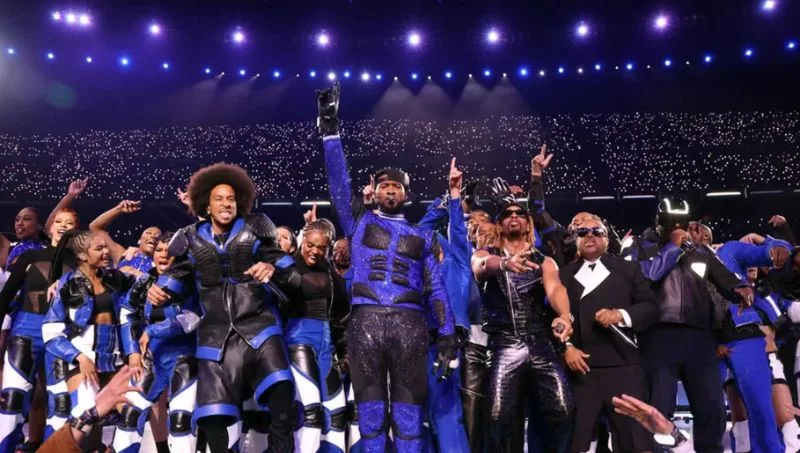

The prefabricated narrative of “Bad Bunny Conquers America” crashes against the cold hard metrics.
Everybody’s waiting for the Taylor Swift show!

But here’s the real insight only 0.5% of media strategists get: this isn’t a flop, it’s a powerful learning moment. It’s the clearest revelation for the next decade of mass entertainment. Nor was it the total success everyone’s trying to sell out of fandom.
The only reality is this: had this show included collaborative English-language music, zero hidden symbolism, and without a “theatrical” push for agendas that clearly create more rejection than support—it would have performed much stronger.
When too many power interests meddle in sports, music, content production, science, politics, business… they destroy the essence of everything. A “collective wisdom” emerges and reacts, even when manipulations are subtle or camouflaged.
The mirage of the Hispanic audience being leveraged to push other themes—like wokeness or tendentious trends disguised as Latinism—while it may generate fandom and unconscious bait, also generates strong rejection. This duality is, deep down, a partial short-term win and a “halftime failure.”

A precise analysis of the new attention economy.
The Raw Arithmetic of Cultural Power
The sequence is undeniable:
2021 (The Weeknd): 102M
2022 (Dre, Snoop, Eminem, Mary J. Blige, Kendrick Lamar): 112M
2023 (Rihanna): 121M
2024 (Usher): 129.3M
2025 (Kendrick Lamar Halftime Show set the record): 133.5M (Historic peak)
2026 (Bad Bunny): 128.2M
Michael Jackson: 133.4M in 1993.
Bad Bunny’s show not only didn’t surpass K.L.’s ceiling, it fell back to levels even below 2024. And this happened with the world’s most-streamed artist, the ultimate Latino icon, in a year when the U.S. Hispanic demographic surpassed 65 million. The thesis of the “Latin conquest” of the mainstream seems, under this scrutiny, an illusion.
What is serious—very serious for the Super Bowl—is that this show allowed a competing broadcast to emerge that didn’t exist before… one that drew nearly half the Halftime audience on YouTube at the same time. This is a drastic fact highlighting a programming and marketing error (but that analysis is for a separate deep-dive).
The mistake is thinking in binary terms: success or failure.
Media expert Timothy D. Carr argues in his 2025 book "The Attention Wars: Why Big Events Don't Mean Big Audiences Anymore" that the paradigm has shifted. “The metric is no longer ‘how many watch,’ but ‘how much value each pair of eyes generates,* and for how many seconds of undivided attention.’” Bad Bunny may not have added 10 million new viewers, but his audience was the most engaged and digitally active in Halftime history. That’s undeniable.
Yet post-event, the reality is that internal meetings haven’t stopped, because internally it was a “failure,” no matter how you spin it.
But in sustainable strategy, this is immediate-term, not necessarily strong and amplifiable. Today, what’s amplifiable and relevant is ultimately more important than impact and shock. Social media content is one thing; an ecosystem is another. For example, F1 is an unparalleled ecosystem. Its strategy isn’t duality, but real, sustainable, amplifiable, relevant value.
An example of something that had no rejection at the Super Bowl, and everyone adored? (PEPSI).

The Bad Bunny Paradox: Engagement vs. Reach
While Nielsen measured TVs on, another battle raged in real time… but is anyone measuring how many people were against it, or in marked disinterest that doesn’t get a hashtag?
The duality-gap, fight… Is this becoming terrible business? Will we return to successes of real value and talent that aren’t “imposed” or the product of shocks alien to the art itself—more about excellence, elevation, superación?
The numbers of immediacy and the other truth to rethink in global sustainable strategy.
-
TikTok LIVE hit a peak of 4.1 million concurrent viewers during the show, a record for a sports event on the platform.
X (Twitter) saw 18.4 million tweets with #BadBunnyHalftime, surpassing #SuperBowl in trends for 47 minutes.
Google searches for "Bad Bunny Super Bowl Jacket" spiked 28,900% in 24 hours. -
Here lies another disruptive truth: The Super Bowl is no longer just a TV event. It’s crossing, phygital like everything else.
-
It’s a content fuel event. Its primary value isn’t delivering 130 million passive viewers; it’s generating 48 hours of atomized, hyper-sharable, culturally relevant content for all digital platforms. Bad Bunny, a master of viral aesthetics and meme-ready performance, delivered that in excess.
No one denies that.
-
Again, what would have happened if the show had no “hidden” symbolism that comes off as obvious—no matter how it’s disguised—with more respect for the American language and spirit, and with other artists integrated into the show?
-
Nielsen’s official report arrives 72 hours post-event and gets attacked for being “slow,” but the truth is unrelated. It’s an analysis that invites thinking beyond the immediate—and some want to silence it because it didn’t give the number they wanted.
Opinions:
-
That delay, in the age of algorithmic speed, is an anachronism. A noted analyst pointed out: “We’re measuring a hurricane with a 20th-century rain gauge. The storm has already passed, wreaking havoc digitally, and we’re still counting drops in a bucket.”…
-
But another show that didn’t exist before was watched on YouTube (digital) this year by 20 million people at the same time. Something needs reviewing, right?
-
Has everything become so fanatical, even among experts, that they want to impose a “total success” even when the numbers—from different methods—invite a review of all strategies and a move away from fandom? Does this reflect hidden emotions, ideologies, or biases affecting art, content, and analysis?
The Truth That Hurts in Newsrooms from Miami to the USA to the World
-
The drop in Bad Bunny’s Halftime Show audience is a symptom of a larger sickness in business and entertainment journalism: the tyranny of emotional immediacy over rigorous analysis.
-
The “reporters and editors” who reported preliminary record numbers committed the cardinal sin of 2026: confusing social trend with quantifiable outcome.
-
The future doesn’t belong to those who shout first. It belongs to those who, like the elite producers already planning (adjustments) for Super Bowl LX, understand that value no longer accumulates in an audience peak, but in the length and depth of post-event engagement.
-
Bad Bunny’s show didn’t break the viewership record. But it may have shattered, forever, the illusion that a social media number defines success.
-
In the new attention economy, everything is more complicated, and we must think much more about the future. The boom of likes is important, sure. But do the 128 million “traditional” viewers who generate 5 billion digital impressions hold more value than 135 million who watch TV and go to bed without posting—but who might actually buy more?
Are social media synonymous with immediate fandom or loyal customers?
The only certainty is that impact is not the same as relevance. Noise is not the same as trajectory. A peak is not the same as continuity. And perhaps the chase for immediacy among entertainment leaders needs to be balanced by a renewed pursuit of sustainable talent.
Final Thought:
Next time you see a headline about a “historic record,” ask yourself: are they measuring yesterday’s world or tomorrow’s?
The NFL, after this data, is already asking that question. And its answer will redefine mass entertainment for the next decade.
5 Strategic Tips Elite Producers Understand (and Emotional Reporters Don’t):
Decouple “hype” from “impact.” Hype is pre-event media noise from PR. Impact is lasting change in brand perception, ticket sales, or post-event streams. Bad Bunny’s show generated monumental hype. Its TV audience impact could or should have been stronger, but that doesn’t mean it was a flop—it’s an alert because, for the first time, it created marked competition… (a rejection so strong it spawned what never existed before: a discontent that another entity capitalized on as direct competition—unthinkable until 2025). And that needs safeguarding. Your lesson: Always measure the final result against a concrete business metric, not against mention volume.
Master the "Micro-Moment" Economy.
A viewer who watches for 30 minutes on TV is 1 Nielsen point. A fan who records a 15-second clip of the show, posts it to TikTok with a sponsored hashtag, and drives 500K views is worth 10x more in attributable engagement and data. Your strategy: Design experiences to be clipped and remixed, not just watched. Create real value. That's why the real, tangible experience beyond TV or social media is also vital.
Understand That Audiences Are Ecosystems, Not Demographics.
Saying "the Hispanic audience" is a mistake. There's the bilingual TikTok audience, the family watching together on broadcast TV via Univisión, the reggaetón purist who streamed it. Bad Bunny strongly appealed to the first and third, but lost segments of the second. Your move: Map the 4-5 micro-ecosystems within your target audience and create a specific hook for each. Not just one. "Divide and conquer" is starting to become outdated. Unite and seek common ground instead of disputes. It's harder, but far more powerful.
The "Official Truth" Arrives Last. The "Digital Truth" Is First.
The preliminary reports and emotional articles proclaiming a record were based on social trends and projections. The Nielsen data is the final Rosetta Stone. Your discipline: In the age of AI, wait. The strategic patience to act on hard data is what separates leaders from followers.
Turn a "Drop" into a "Recalibration."
For the NFL and its sponsors, a 4% drop in TV audience paired with a 300% peak in Gen Z social engagement isn't a loss. It's a signal that the business model must pivot. The next Halftime Show rights contract won't be sold on TV ratings alone; it will include clauses for social media amplification, digital merchandising, and data sharing. Your vision: Don't cry over an obsolete KPI. Invest in the one that's rising. Nothing is more important than sustained satisfaction. Everyone's chasing social media impact—what's vital is what you do for people in a real, sustained way.
Read Smart, Be Smarter!
https://infonegocios.miami/subscribe-to-newsletter
Contact: [email protected]
Infonegocios NETWORK: 4.5 million Anglo-Latinos united by a passion for business.
Join us and stay informed.
© 2025 Infonegocios Miami.

Infonegocios Miami—Economic, Cultural, and Business Intelligence with a Global Lens





Tu opinión enriquece este artículo: