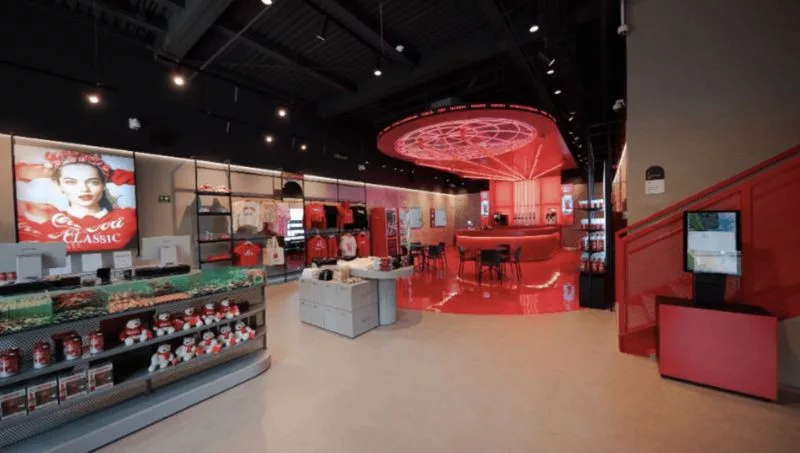

Another proof of the crossing marketing era — the 80s and 90s have returned, revived by AI, technology, and social networks.
Forget TV ads or online campaigns alone. Erase from your mind the idea that paid media is all that matters. What Coca‑Cola has inaugurated in Polanco, Mexico City, is not a store. This isn’t a flagship store. It is a dimensional portal to a meaning ecosystem. When Louis Balat, Coca‑Cola Mexico’s President of Operations, says this space “reflects our commitment to innovation and to creating exclusive experiences,” he is being modest. What he is really doing is redefining the contract between megabrands and humanity: we are no longer consumers; we are pilgrims seeking rituals of belonging.

Deconstructing the House: Anatomy of a Branded Universe
The Coca‑Cola House operates on a completely new layer of reality, one that transcends mere commerce. It is the embodiment of the Phygital Universe, where the physical and the digital do not merely mix; they merge to create a third thing: an immersive experience.
-
The Liquid Bar: Where Flavor Becomes Ceremony
The Coca‑Cola Liquid Bar isn’t a drinks counter. It’s a temple of algorithmic flavor. Offering “1886-style preparation” isn’t nostalgia; it’s brand archaeology. It links the present to the original big bang, establishing a sacred timeline. Local-flavor recipes (like chili or mango) aren’t variants; they are acts of soft cultural colonization, where the brand injects itself into the local DNA to become indispensable.
-
Personalization as Sacrament
Personalizing cans with names isn’t a gimmick. It’s the ritual of individuating within the mass. In a world of mass production, this act turns a common object into a personal relic, a totem of identity. The visitor doesn’t buy a Coca‑Cola; they buy the tangible proof of their own singularity, validated by the planet’s most recognizable logo.
-
Merchandise as an Extension of Self
-
Exclusive clothing and accessories aren’t merchandising; they’re tribe insignia. Wearing a limited-edition Coca‑Cola jacket signals allegiance to a universe of values (happiness, universality, optimistic nostalgia) that the brand has masterfully captured.
-
As branding guru Martin Lindstrom argues in Brand Sense, “21st‑century brands will not occupy shelf space; they will occupy the emotional-biographical space of the consumer.” The Coca‑Cola House is the vehicle to achieve precisely that.
-
The Human Resource Play: The Ideal Talent Mix Falls Short
What you need today are multitalented leaders who can create expansive brand universes with medium- and long-term objectives. They are Heads of Culture, able to juggle multiple tasks, bridge offline and online worlds, and, above all, have the resilience to craft human, thematically rich experiences.
The Historical Context: From Bottle in Store to Themed Planet
This movement is not spontaneous. It represents the final link in a decades-long evolutionary chain:
-
Product Era (1886-1950s): “Here’s the drink.”
-
Image Era (1960s-1990s): “Here’s the lifestyle (the spark of life!).”
-
Experience Era (2000s-2010s): “Here’s the moment (Open Happiness).”
-
Universe Era (2020s-...): “Here’s the alternate world you can live in.”

Coca‑Cola has moved from selling a beverage to selling an emotional framework for existence. The House is the contemporary equivalent of medieval cathedrals: a space that defines reality around it, attracting pilgrims and selling indulgences (in the form of personalized cans).
-
Choosing Mexico City isn’t accidental. As Balat noted, it’s where “global culture and Mexican identity converge.” It’s the perfect lab for a brand that aspires to be glocal: global in scale, local in resonance. Polanco, the Mexican Beverly Hills, provides the luxury and aspirational context needed.
15 Neuro-strategic Tips to Decode the Brand Universe
To help your strategist’s mind grasp the blueprint:
-
The product is no longer the center. The consumption ritual surrounding the product is the new nucleus.
-
The House doesn’t sell Coca‑Cola; it sells “the right to feel part of Coca‑Cola’s myth.”
-
The Liquid Bar is the altar where the product is transubstantiated into experience.
-
Personalization is the antidote to digital depersonalization. It gives control in a world of algorithms.
-
Music and sensory stimuli are not mere ambiance; they are a brand cocoon that prevents you from thinking about anything else.
-
Merchandise is physical social proof of your tribe loyalty.
-
Polanco isn’t a location; it’s a positioning statement: premium, accessible luxury, high/low culture.
-
The “journey” is designed to slow time, forcing you to absorb every layer of the brand universe.
-
Coca‑Cola doesn’t compete with Pepsi here. It competes with Disney, immersive museums, and Instagram for your leisure time and identity.
-
This is beta phase of a distributed theme park. Imagine Coca‑Cola Houses in every global capital, each with a local twist.
-
The data collected here (preferences, names, time spent) is pure gold to refine the brand’s emotional algorithm.
-
Strategy: attract, immerse, and convert into ambassadors. You’ll leave with a can bearing your name and tell everyone.
-
They are building a closed ecosystem: you drink the beverage, wear the clothes, live the experience. Loyalty is total.
-
Real ROI isn’t daily sales. It’s the lifetime value of a customer who now sees Coca‑Cola as a hobby, not just a beverage.
-
This is the blueprint to follow. Brands that don’t build physical experiential planets will be relegated to commodities on a digital shelf.

Impact on Miami and the Future of Experiential Retail
-
For Miami, a global hub of luxury experiences and entertainment, the Coca‑Cola House is both a warning signal and a compass. The city’s cultural mix and appetite for novelty make it fertile ground for the next House.
-
The future of retail isn’t about selling more; it’s about selling better through immersion. Traditional marketing departments are dead. Meta-departments with hybrid talent are needed: storytellers, neuro scientists, experience architects, DJs, data artists.
-
As Balat put it: “We want it to be a source of inspiration and creativity, a place where everyone feels part of something extraordinary.” The fundamental truth remains: in the attention economy, a brand’s greatest aspiration is no longer to be loved, but to be the stage where people live their own stories.

The Birth of the Brand Planet
-
The opening of the Coca‑Cola House marks a tipping point in the history of consumption. It signals the moment when the world’s most powerful brands stop asking for space in our lives and begin building alternate worlds for us to inhabit.
-
It isn’t a store. It is a cultural mothership. And its arrival in Mexico is just the first landing. Soon we’ll see these ships touching down in all the capitals of global desire, from Miami to Tokyo, creating a constellation of brand planets orbiting the same sun: eternal emotional loyalty.
-
The brutal, simple question for your business is: are you selling a product, or are you building a universe so captivating that people want to live in it?
-
The model is here. The blueprint is on display. The war for the future of consumption has entered a new dimension. Literally.
Read Smart, Be Smarter.
Infonegocios Miami—Economic, Cultural, and Business Intelligence with a Global Lens
Síguenos para más análisis: @InfonegociosMiami
Read Smart, Be Smarter!
https://infonegocios.miami/suscribite-al-newsletter
Contact: [email protected]
Infonegocios NETWORK: 4.5 million Anglo-Latinos united by a passion for business.
Join us and stay informed
© 2025 Infonegocios Miami.

Tu opinión enriquece este artículo: