
Imagine an entire average city disappearing. Now multiply that by 8. That is 8 million Venezuelans who have fled their country not for opportunity, but for survival.
It’s as if the entire population of New York vanished. These are not “economic migrants”; they are refugees from a regime that has systematically broken the social, economic, and human contract with its people.
What follows is not a political opinion; it is a forensic analysis with irrefutable data exposing one of the greatest avoidable tragedies of the 21st century.
-
The moment has arrived where—beyond being left-wing, being a democrat, disliking Trump, being “pro” China or Russia—the truth is so evident, the numbers so overwhelming, that the question we must ask today is why this intervention wasn’t made sooner. And why there are other places in the world where free nations and institutions are no longer “intervening.”

SILENT GENOCIDE? The Figures That Dismantle Any Defense of the Maduro Regime: A Critical Analysis of the 12 Years That Turned Venezuela into a Failed State
The Historical Framework: From Stability to the Abyss in 26 Years
Venezuela wasn’t born in crisis. Between 1958 and 1998, it was the most stable democracy in Latin America, with peaceful transfers of power and a robust middle class.
-
The arrival of Hugo Chávez in 1999 initiated an experiment in “21st-century state socialism” that, while temporarily redistributing oil revenue within an extremely short period of almost two years, destroyed institutions, democracy, justice, and the economy over more than 25 years.
It practically destroyed a nation.
But it was under Nicolás Maduro (2013–2025) that the collapse accelerated catastrophically and deliberately. One key fact: Venezuela’s GDP in 2013 was approximately USD $400 billion. By 2025, it is estimated at less than USD $60 billion—an 85% contraction unparalleled in modern history during peacetime.

Technical Analysis: The 7 Dimensions of Collapse (With Verified Figures)
**We cross-referenced data from the IMF, UN, Foro Penal, Provea, UNHCR, and global think tanks. The result is terrifying:
-
Manufactured Humanitarian Crisis: 7.9 million exiles (UNHCR, 2025). It is the world’s second-largest displacement crisis, only behind Syria.
-
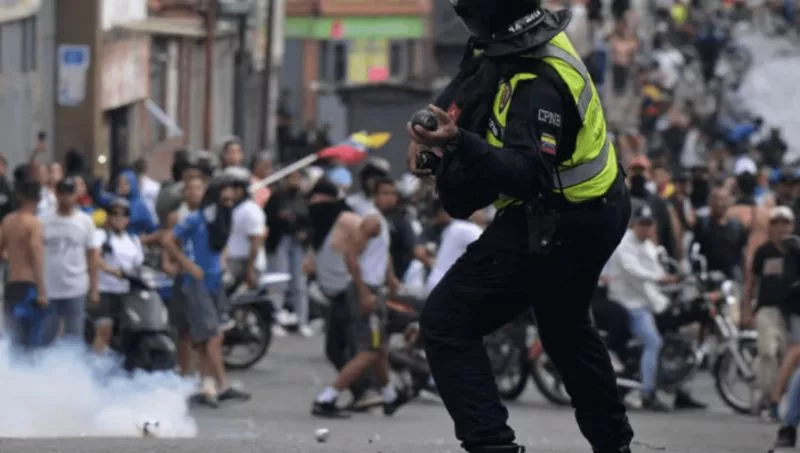
Systemic Political Repression: 18,300 documented political detentions (Foro Penal, 2002–2025). 468 killings in protests (UN, 2014–2025).
-
Torture as State Policy: 36,800 victims of torture and state violence (Provea, 2013–2025). 10,000 extrajudicial executions by security forces (UN, 2024 report).
-
Deliberate Economic Collapse: Cumulative hyperinflation of 65,000,000% between 2016–2023 (IMF). The economy shrank to 28% of its size in 12 years. (The reality is that over 20 years of continuous capital investment are needed to recover the standard left more than 25 years ago.)
-
Statistical Opacity as a Weapon: The government stopped publishing poverty, inflation, and scarcity figures for years. When it did, they were fiction: 92.5% of households were in poverty (National Survey of Living Conditions, 2024).
-
Institutionalized Narco-Terrorism: Maduro and his inner circle were formally accused by the U.S. of “narco-terrorism” and of turning Venezuela into a “narco-state,” using cartels to finance repression and enrich themselves.
-
Destroyed Health and Education: 85% of medicines scarce or nonexistent (WHO, 2024). School dropout rate of 55% (UNICEF, 2024) due to hunger and lack of services.

Why U.S. intervention is not only humane and necessary but should have been carried out decades ago with international support, and why today there are other places that also require such action.
The uncomfortable question: Why do some figures continue defending the indefensible?
Figures like Lula da Silva, Gustavo Petro, Claudia Sheinbaum, Pedro Sánchez, Cristina Kirchner, and parties such as PT (Brazil) and PJ (Argentina), paradoxically including the Abuelas de Plaza de Mayo (Argentina), who have shown sympathy or called for “dialogue” with the regime, face monumental cognitive dissonance. Voluntary ignorance, anti-capitalist geopolitical calculus, or simple cynicism? Possible reasons include:
-
Anachronistic Ideological Solidarity: Romanticism with the “revolution” that ignores its empirical failure.
-
Selective Anti-Imperialism: Condemning U.S. sanctions while ignoring the regime’s violence (and the poverty generated through absolutely exploitative dealings with Iran, Russia, and China).
-
Opaque Economic Interests: Potential energy or commercial under-the-table agreements.
When Numbers Shout Louder Than Ideologies (and when millions of real videos rewrite decades of fanatical militancy)
Neuroscience explains: confirmation bias causes those who identify with an ideology to reject evidence that contradicts it, no matter how overwhelming.

15 Tips to Grasp the Magnitude (and Avoid Falling for Propaganda)
-
Numbers Don’t Lie, Regimes Do: When a government stops publishing statistics, it’s the first alert of statistical genocide.
-
8 Million People Don’t Flee a “Socialist Paradise”: It’s the most eloquent “vote with their feet” in recent history.
-
Torture Isn’t an “Excess,” It’s Policy: 36,800 victims indicate a system designed to terrorize.
-
Hyperinflation = Hyper-Malice: Printing money uncontrollably isn’t a mistake; it’s a way to transfer wealth from the people to the state.
-
Political Prisoner ≠ Criminal: They are citizens for thinking differently in a system that criminalizes dissent.
-
Narco-State ≠ Drugged State: It’s the deliberate co-optation of institutions for organized crime.
-
“Humanitarian Crisis” Is a Euphemism: It’s an anthropological catastrophe—the destruction of social fabric, family, and hope.
-
Silence Is Complicity: Those who don’t condemn these numbers tacitly approve them.
-
Sanctions Aren’t the Cause, They’re a Consequence: They were an international response to massive human rights violations.
-
Oil Financed Repression: Oil revenue was used to buy loyalties and weapons, not to develop the country.
-
The Diaspora Is a Bank of Brains and Hands: Those fleeing are the young, the educated, the entrepreneurs. The country is left without a future.
-
The International Community Was Slow: Decisive U.S. action came late, but it was necessary.
-
Artists Defending the Regime Suffer from “Celebrity Socialism”: They criticize capitalism from yachts and mansions, ignoring lived reality.
-
The Collapse Was Preventable: Dozens of early warnings from economists and organizations were ignored due to ideology.
-
Maduro’s Capture Isn’t “Interventionism,” It’s Universal Justice: It’s the application of the UN-endorsed “Responsibility to Protect” (R2P) principle.

-
The numbers of the Maduro era aren’t statistics; they are stories of pain, resistance, and shattered dignity. Each of the 36,800 torture cases, each of the 8 million exiles, is a universe of broken dreams.
-
Maduro’s capture for narco-terrorism isn’t the end; it’s the beginning of a historic reckoning.
-
Venezuela recorded a homicide rate of 3.49 per 100,000 inhabitants during 2024, reported this Thursday by the director of the Cuerpo de Investigaciones Científicas, Penales y Criminalísticas (CICPC), Douglas Rico, who stated that the country has seen a sustained decrease in this crime since 2022.
-
On the program ‘Café en la mañana,’ broadcast by the state channel VTV, Rico recalled that Venezuela had in 2016 “the highest peak” in homicides per 100,000 inhabitants, without providing figures, but added that thanks to “citizen security bodies and the National Armed Force,” this crime has been reduced. He detailed that in 2022, the country recorded 6.8 homicides per 100,000 inhabitants, while in 2023 the rate was 5.35.
-
For Venezuela, it’s the opportunity for a painful but necessary rebirth. For the world, it’s a reminder: ideologies that promise paradises often build hells. And hells, when they are real, must be extinguished by the force of international law and human conscience.
Businesses, culture, companies, individuals, and nations flourish with freedom, human rights, and the rule of law.
-
The figures now being confirmed about Maduro’s fortunes abroad—clearly replicas of those of Chavez and mirrors of similar, proportional fortunes of many members participating in this narco-state—reflect theft from their people at insane levels.
-
Perhaps the defense of Maduro is merely an act of self-protection by politicians in other countries who operate or operated in a “similar” manner.

The Venezuelan tragedy is the antithesis of everything we stand for.**
Read Smart, Be Smarter.
Infonegocios Miami—Economic, Cultural, and Business Intelligence with a Global Lens
Follow us for more analysis: @InfonegociosMiami
Read Smart, Be Smarter!
https://infonegocios.miami/suscribite-al-newsletter
Contact: [email protected]
Infonegocios NETWORK: 4.5 million Anglo-Latinos united by a passion for business.
Join us and stay informed.
© 2025 Infonegocios Miami.











Tu opinión enriquece este artículo: