Global impact: OpenAI rolls out ChatGPT’s first worldwide campaign—the era where even AI has to do crossing marketing…

(By Maurizio and Taylor) This isn’t just advertising; it’s a phygital ecosystem (not only online) designed to colonize the collective mind. An exclusive analysis of the strategy redefining human–machine engagement.

(High‑value read: 3 minutes)

  1. How AI is rewiring marketing from neurons to media—and how coherence is back to the ’90s, plus online and AI.

  2. If you work in marketing, tech, or media, study this campaign with a fine-tooth comb. This isn’t another case study; it’s the playbook for the next decade. AI is no longer an IT topic; it’s the core of the engagement strategy.

  3. Since 2017, major brands and digital giants have made a glaring mistake: abandoning real‑world experience teams—brand ambassadors, signage, vans, flags, offline marketing managers, publicists. AI and online are major advances, but they’re contributions—not replacements for real life.

This campaign proves it. (Watch)

https://www.youtube.com/watch?v=To04SSylvVY

This isn’t just another campaign; it’s hard evidence that we live in a phygital, crossing era—real experiences amplified across categories, moments, and actions.

Whether you’re a mega online company or an auto, apparel, or AI agency, hire teams and talent who can build a booth, fill a shelf or a storefront, produce merch or spots, craft written content or OOH campaigns—and who also know how to use AI to distribute video from a real‑world event.

Another example, the spot:

https://www.youtube.com/watch?v=IqC3YrIzbQw&t=2s

Welcome to the crossing era.

OpenAI isn’t competing with other AIs; it’s competing for human attention. This campaign is the first step toward the cultural domestication of AI as an everyday, almost human presence.

“When artificial intelligence learns marketing, it stops selling products—and starts selling pieces of the future.”


The campaign as a neuro-communication artifact

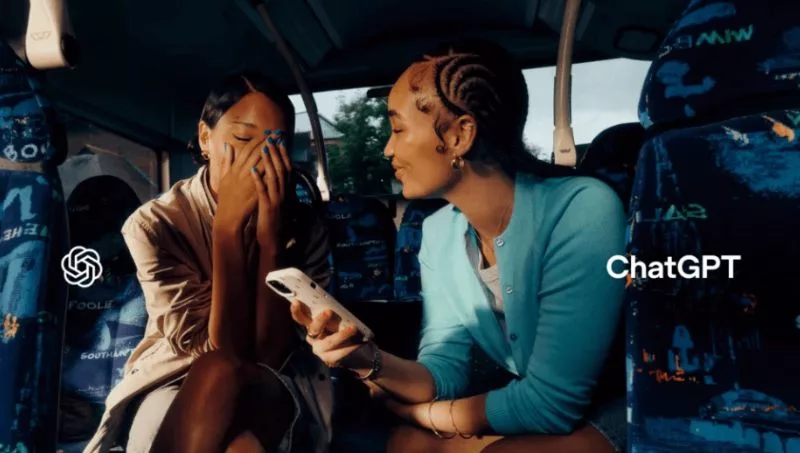
OpenAI isn’t just dropping ads; it’s orchestrating a global perception architecture. ChatGPT’s international campaign—following its Super Bowl 2025 appearance—is the first deliberate move by an AI to self‑promote as a relational entity, not merely a tool.


  1. Key elements:


  • 30-second spots: produced by the in‑house team + Isle of Any + Miles Jay.


  • Out‑of‑home and digital: omnichannel expansion.


  • Real‑life narratives: cooking, travel, training—everyday, emotionally charged situations.


This is not a product campaign; it’s positive conditioning toward AI.


Phygital strategy: where digital and physical collide

  1. OpenAI is executing full‑spectrum sensory integration:


  • Physical: billboards, transit, high‑traffic urban placements.


  • Digital: adaptive social content, programmatic, influencers.


  • Emotional: spots highlighting “moments of discovery”—dopamine peaks in daily life.


The goal isn’t to sell; it’s to normalize AI’s presence until it’s indistinguishable from the air you breathe.


Applied neuromarketing: why this campaign works

  1. Each element is designed to trigger preconscious responses:


  • Visual neuro‑architecture: color, cadence, human faces to build trust.


  • Emotional copy: “small moments of discovery”—language that sparks curiosity and reward.


  • Everyday context: AI appears not as technology but as an invisible companion.


Quote from Elke Karskens (OpenAI):

“We want users to experience small moments of discovery, productivity, and creativity.”

That line is a linguistic algorithm anchoring ChatGPT to positive emotions.


Timing and precedent: why now?

  1. OpenAI has moved through phases:


  • Tech phase (initial launch).


  • Utility phase (Microsoft integrations, APIs).


  • Emotional branding phase (this campaign).


It’s the same arc we saw from Google, Apple, and Facebook: utility first, brand identity next.

Recommended references (for deeper dives):


  • Books: Prediction Machines by Ajay Agrawal; AI Superpowers by Kai‑Fu Lee.


  • Experts: Elke Karskens (OpenAI); marketing leaders at Google Brain, DeepMind.


  • Academic models: neuromarketing applied to AI; human–machine integration theories.


© 2025 Infonegocios Miami. 


 Read Smart, Be Smarter!

https://infonegocios.miami/suscribite-al-newsletter

Infonegocios NETWORK: 4.5 million Anglo-Latinos united by a passion for business.

 Join us and stay informed:

 Contact Infonegocios MIAMI:

 [email protected]

Tu opinión enriquece este artículo:

El nuevo presente del marketing: insights desde la Fórmula 1 y su ecosistema de experiencias (donde las mejores marcas cocrean, ¿y la tuya?) (parte II)

(Por Taylor y Maurizio) En un mundo donde la atención es el recurso más escaso, las últimas tendencias en marketing han llevado a las marcas a repensar sus estrategias. La Fórmula 1, con su despliegue de multi-activaciones y un enfoque cultural integral, ofrece un modelo a seguir en la creación de experiencias únicas e inolvidables.

(Contenido de alto valor estratégico, 4 minutos, información ideal para compartir)

El ecosistema de la F1 ha reescrito las reglas del marketing global (¿tu marca las está aplicando en el 2026?) (parte I)

(Por Taylor y Maurizio) Imagine por un momento que su marca puede generar la lealtad fanática de 1.500 millones de seguidores globales, multiplicar su valoración en un 40% anual y crear experiencias que trascienden lo transaccional para convertirse en rituales culturales. 

(Contenido de alto valor estratégico, 4 minutos, información ideal para compartir)

American Airlines invierte US$ 1.000 millones que revolucionará el Aeropuerto Internacional de Miami (hasta el infinito y más allá)

(Por Taylor, con Maqueda, edición Maurizio) En una jugada que promete transformar el panorama de las aerolíneas y los viajes internacionales en Estados Unidos, American Airlines ha anunciado una inversión de USD $1,000 millones destinada a la ampliación de la terminal D del Aeropuerto Internacional de Miami (MIA). 

(Lectura de valor, 4 minutos de lectura, material idea para compartir)

American Airlines le da otro vuelo a MIA (Miami Internacional Airport)

(Por Taylor, edición Maurizio) La aerolínea ha anunciado una inversión monumental de USD $1,000 millones para la ampliación de la terminal D en el Aeropuerto Internacional de Miami (MIA), un proyecto previsto para iniciar en 2027 que promete transformar radicalmente la experiencia del viajero.

(Lectura de valor, 4 minutos de lectura, material idea para compartir)

Miami: el campo de batalla de los eVTOLs y la realidad tras la fiebre de los taxis aéreos

(Por Taylor) Si hace unos días celebramos el anuncio de Archer Aviation y su modelo Midnight, hoy debemos ampliar el foco: Vertical Aerospace, fabricante británico, acaba de presentar en Miami Beach su modelo Valo, un eVTOL diseñado para cuatro pasajeros —incluyendo mascotas— y con una propuesta que busca democratizar el transporte aéreo urbano. 

(Contenido de alto valor estratégico, 4 minutos, información ideal para compartir)

Miami, capital mundial de la movilidad aérea urbana: así revolucionan los eVTOLs el transporte en 2026 (parte I)

(Por Taylor) En la intersección entre innovación, lujo y eficiencia, Miami consolida su posición como el epicentro global de la vanguardia tecnológica y empresarial. La noticia que está resonando en todos los circuitos de élite: Archer Aviation ( ojo +Vertical Aerospace ahora, en la siguiente nota)

(Contenido de alto valor estratégico, 4 minutos, información ideal para compartir)

¿Por qué Ferrari tiene razones para soñar en la F1 2026? (Miami, Maranello y el mundo vibran al rojo vivo)

(Por Maqueda-Maurizio) En el horóscopo chino, 2026 es el año del caballo de fuego, un símbolo de energía indomable, velocidad vertiginosa y carácter audaz. Pero lo más lindo…Ferrari ha sorprendido a todos con la presentación de su nuevo monoplaza SF-26 en sus últimos ensayos en Bahréin y sus tiempos. 

(Contenido de alto valor estratégico, 4 minutos, información ideal para compartir)