
Analyzing the inflationary impact in Latin America and the measures adopted by other countries in the region, the primary concern lies in Argentina's impact on the economy of the Americas and the significant decline that Colombia has begun to experience. Argentina continues to occupy the third position in the global annual inflation ranking in May, making it the country with the highest monthly price increase in Latin America.
According to data provided by the National Institute of Statistics and Census (Indec) in Argentina, the country's inflation reached 7.8%, surpassing the 7.6% recorded the previous month by the Venezuelan Finance Observatory (OVF) in Venezuela. In contrast, the rest of the region experienced an inflation rate of less than 1% in the same period.

The question arises: Why is inflation decreasing throughout the Americas while it keeps rising in Argentina?
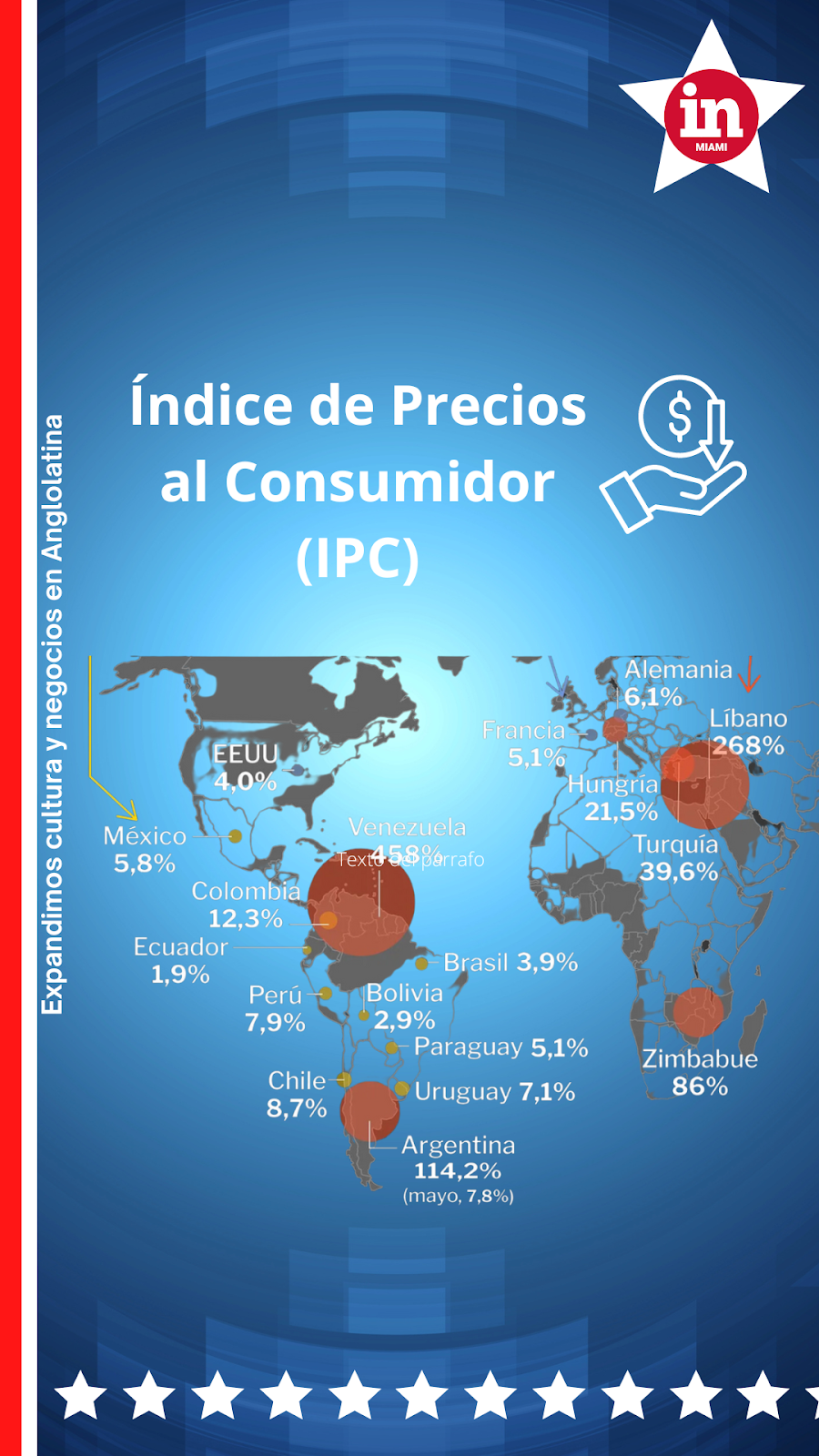
In May, Argentina ranked third in the global annual inflation ranking, with a 7.8% price increase. Within Latin America, it had the highest monthly price surge. Venezuela and Lebanon are the only countries that surpassed Argentina's price increases in the last 12 months. Most Latin American countries have managed to control inflation by adopting measures such as reducing interest rates.
Argentina maintains one of the highest nominal interest rates globally, but in real terms, it becomes negative due to high inflation projections. It is necessary to implement solid and effective measures to control inflation and achieve economic stability.
The economic outlook for Argentina is not promising, as it is projected that year-on-year inflation will continue to rise, despite a possible decrease in the monthly data for June. Several countries in the region have decided to lower their interest rates after a period of adjustment due to monetary issuance during the pandemic and price increases caused by the war in Ukraine.
In contrast, the Central Bank of Argentina maintains one of the highest nominal interest rates globally. However, in real terms, these rates turn negative due to inflation forecasts of 171% for the next 12 months. Although the BCRA has decided not to adjust the rates again in the short term, it is expected to continue adjusting the official exchange rate below the inflation rate as a measure to stabilize an economy in crisis with negative short-term prospects.
This analysis of inflation in Argentina and Latin America shows the need to implement solid and effective measures to control this economic problem. As the countries in the region adopt appropriate policies, it will be possible to achieve economic stability that benefits all citizens and promotes sustainable growth.

Inflation: How is the world doing?
Globally, only Venezuela and Lebanon have surpassed Argentina in terms of price increases in the last 12 months, with increases of 458% and 268%, respectively. Argentina has recorded an increase of 114.2% since May 2022.

In the Latin American context, most countries have managed to control inflation by adopting various measures. Colombia, governed by Gustavo Petro, recorded inflation of 0.4% last month and 12.3% in the past year. Chile ranked second with 0.1% and 8.7%, respectively. Peru ranked fifth in the annual ranking with 0.3% in May and 7.9% in a year, followed by Uruguay with 0% and 7.1%.
What lessons can America and the world learn from the poor policies of Argentina and Venezuela?
The inflationary situation in Argentina is concerning, and Venezuela has been suffering from this impoverishing scourge for decades. However, there are lessons that can be learned from other countries that have faced similar problems. Some measures that could be useful to combat inflation in Argentina include:
-
Responsible monetary policies: The Central Bank must maintain disciplined and adjusted monetary policies that align with economic conditions, avoiding excessive money issuance.
-
Prudent fiscal policies: The government should implement responsible fiscal measures, avoiding uncontrolled fiscal deficits and excessive reliance on monetary issuance to finance expenses.
-
Structural reforms: A series of structural reforms are needed to enhance the efficiency and competitiveness of the economy, promote investment, and foster sustainable growth.
-
Investment promotion and job creation: Attracting investments and generating formal employment will contribute to boosting the economy and reducing inflationary pressures.
-
Macroeconomic stabilization policies: Policies promoting macroeconomic stability, such as controlling the money supply, stabilizing the exchange rate, and reducing economic uncertainty, should be implemented.
Fundamental tips:
-
Drastically reduce inefficiency and the overstructure of the state. (Argentina, Venezuela, and Colombia have significant unproductive public spending.)
-
Reduce the tax burden.
-
Restructure and adapt labor laws to current economic conditions.
-
Decrease the state's economic weight and avoid statist systems that encourage bureaucracy and hyper corruption.
-
Focus on exports and production.
-
Attract investments through legal, social, and economic-financial guarantees.











Tu opinión enriquece este artículo: