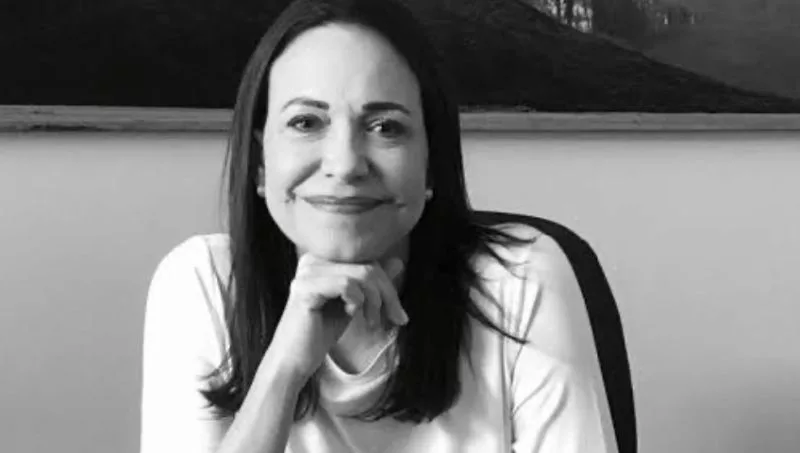

Jørgen Watne Frydnes, chair of the Norwegian Nobel Committee, put it with stark clarity: “When authoritarians take power, it is crucial to recognize the brave defenders of freedom who stand up and resist.” This is not diplomatic rhetoric. It’s an action memo for democracies under siege in the 21st century.
The silence that roars louder than bullets and tyranny. There are moments in history when a prize isn’t merely recognition—it is an act of justice and symbolic, peaceful resistance.
The video capturing the emotional moment when Corina Machado is informed of her Peace Prize nomination:

The Nobel as a Geopolitical Instrument of Peace: Precedents and Consequences
The Nobel Peace Prize has never been politically neutral. Consider Liu Xiaobo (2010), the imprisoned Chinese dissident; Aung San Suu Kyi (1991), under house arrest in Myanmar; or Lech Wałęsa (1983), who challenged Poland’s communist regime. In every case, the award was a direct challenge to authoritarian systems—a moral shield for persecuted figures.
From the entire Infonegocios Miami community—Latinos from every nation in the Americas and Spain, Anglos, business leaders, technologists, entrepreneurs, cultural and arts figures, journalists, strategists, and writers—we are not only happy, proud, and moved; we are deeply hopeful.
For over four years, we have undertaken journalistic, investigative, communications, and collaborative initiatives to expose the horrors of the totalitarian, antidemocratic Chavista regime—now led by Maduro—while holding up a mirror to the absurd neutrality of many institutions and heads of state and underscoring the complicity of governments such as those of Petro, Lula, AMLO, now Claudia Sheinbaum Pardo, CFK, and Alberto Fernández.
We have also called out the unacceptable stance of organizations such as Abuelas de Plaza de Mayo (Argentina), which should be first in line to support the clear victory of the opposition in Venezuela and speak out against the torture, deprivation, and crimes of an extreme socialist, statist, despotic, and tyrannical government that seized the Venezuelan nation decades ago.
Equally, we have shown—with evidence, independent of political preferences—that administrations like Trump’s are pivotal today, and others like Javier Milei’s, as they actively contribute to the fall of these statist, antidemocratic totalitarianisms.
Finally, we have collaborated with journalists such as Nelson Castro and Carolina Amoroso in Argentina and Emmanuel Rincón in Venezuela, and organizations like Vente Venezuela, which are vital in amplifying what many media outlets choose to silence.

Anatomy of a Despotic Regime: Maduro as Case Study
To grasp the magnitude of Machado’s recognition, we must dissect the architecture of Chavista–Madurista power. Since Hugo Chávez’s death in 2013, Nicolás Maduro has refined what political scientist Steven Levitsky terms “competitive authoritarianism”: regimes that preserve electoral facades while capturing institutions, criminalizing dissent, and manipulating outcomes.
The pillars of Maduro’s control:
-
Total institutional capture: The National Electoral Council (CNE), the Supreme Court, and the military operate as extensions of the executive.
-
Selective disqualification: Machado was arbitrarily barred from the 2024 presidential race, forcing the opposition to put forward Edmundo González, an academic with no electoral track record.
-
Calibrated repression: More than 20 deaths in post-electoral protests, thousands of arbitrary detentions, and arrest warrants for opposition leaders in exile.
-
Managed diplomatic isolation: Severed ties with Argentina, Brazil (temporarily), Chile, and European nations, while maintaining alliances with Russia, China, Iran, and Cuba.
Venezuelan sociologist Margarita López Maya, in her work Protesta y Cultura en Venezuela, warns that such regimes do not collapse solely due to external pressure but also through internal fractures among military and economic elites. Machado understands this.
That is why she remains in Venezuela, underground—a living symbol of internal resistance.
The Nobel as a Geopolitical Weapon: Precedents and Consequences
What does this Nobel mean for Venezuela?
-
International legitimization of the opposition: Machado and González now possess symbolic capital no democratic government can ignore. The prize turns any future repression against them into an immediate global scandal.
-
Pressure on Maduro’s allies: China and Russia—powers that prefer geopolitical stability over ethical instability—will be forced to recalibrate. Beijing, in particular, has historically adjusted its backing when reputational costs outweigh economic benefits.
-
A reconfigured migration map: The recognition strengthens the narrative of “legitimate political exile,” easing asylum and international protection processes for Venezuelans. This has direct implications for Miami, Orlando, Houston, and other cities with significant Venezuelan diasporas.
-
Doctrine of humanitarian intervention: Machado’s dedication to President Trump and her explicit support for U.S. “military pressure”—including naval deployments near Venezuela—reignite debates on sovereignty, intervention, and the role of hemispheric powers in democratic transitions.
Miami: The Emotional, Economic, and Political Epicenter of the Resistance
Miami is not merely a destination for migrants. It is a laboratory of democracy in exile, where Latin American diasporas reforge identities, build economic power, and exercise transnational political influence.
Key data on the Venezuelan diaspora in South Florida:
-
Over 200,000 Venezuelans reside across Miami-Dade, Broward, and Palm Beach, per estimates from the Pew Research Center and the Migration Policy Institute.
-
68% hold university or graduate degrees—among the highest rates of any migrant community in the United States.
-
They have founded more than 15,000 businesses across technology, financial services, healthcare, gastronomy, and consulting.
-
Remittances from Florida to Venezuela exceed USD $800 million annually, a lifeline for millions of families.
© 2025 Infonegocios Miami.
Read Smart, Be Smarter!
https://infonegocios.miami/suscribite-al-newsletter
Contact: [email protected]
Infonegocios NETWORK: 4.5 million Anglo-Latinos united by a passion for business.
Join us and stay informed










Tu opinión enriquece este artículo: