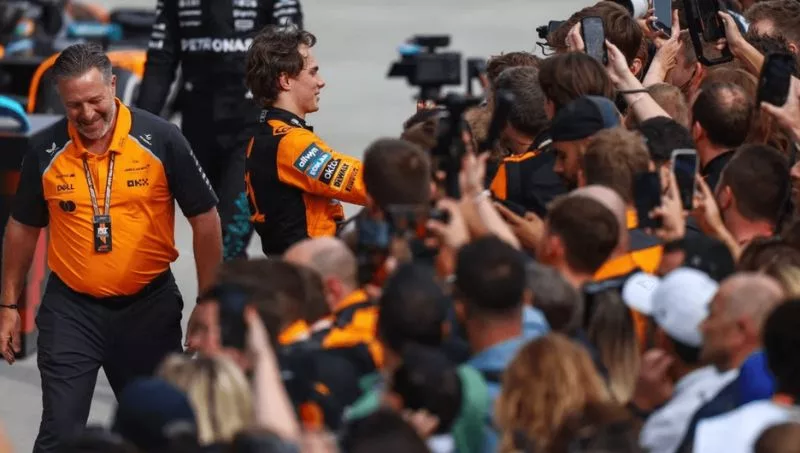

This isn’t just a sale. It’s a paradigm shift.
McLaren Racing’s recent USD 4.1 billion valuation, following the acquisition of 100% of its shares by Mumtalakat (Bahrain) and CYVN Holdings, isn’t an isolated event: it’s the culmination of a masterclass in global repositioning, transmedia expansion, and the monetization of immersive experiences in Formula 1. This move not only underscores the category’s current financial strength; it sets a new benchmark for team valuations in the attention‑economy era.
The fusion of elite performance, technology, crossing marketing, and immersive experience (the age of making everything relevant—backed by outsized investment).
“McLaren no longer races for championships; it races for the world’s attention. And in that race, it just took pole position.”

Historical context: From crisis to global dominance
-
McLaren hasn’t always been synonymous with success. In the early 2020s, the team was battling in the lower midfield. Under Zak Brown — a visionary in both marketing and sports management — McLaren executed a transformation built on:
-
Technical innovation: Aggressive investment in aerodynamics and CFD simulation.
-
A hybrid business model: High‑profile sponsorships (Google, Mastercard) plus expansion into categories like Extreme E and Esports.
-
Emotional narrative: Capitalizing on the underdog story and humanizing drivers and team.
This rebirth isn’t just sporting; it’s a case study in organizational resilience and luxury branding applied to sport.
Neuroeconomics and perceived value: Why McLaren is worth more than many Fortune 500 companies
-
The USD 4.1 billion valuation isn’t only about on‑track results. It’s anchored in:

-
A data culture: Advanced analytics on social engagement, impression‑based sponsorship valuation, and global audience metrics.
-
The experience economy: McLaren doesn’t sell races; it sells immersive experiences (VIP hospitality, simulators, metaverse integrations).
-
Applied neuromarketing: Narratives of overcoming (dopamine), rivalry (adrenaline), and exclusivity (oxytocin) to lock in fan loyalty.
This is the first F1 team to truly treat its product not as the car, but as the collective emotion it generates.
Zak Brown’s playbook: Architect of the modern McLaren
-
Brown isn’t a sporting director; he’s a global entertainment CEO. Key moves:
-
Revenue diversification: Tickets, merchandise, licensing, original content (McLaren Plus), and partnerships with luxury brands.
-
Cross‑category expansion: Presence in F1, IndyCar, Extreme E, and Esports, creating a unified brand ecosystem.
-
Financial governance: Leveraging the cost cap to maximize ROI and attract institutional investors.
Brown’s money quote: “The sport is on fire. We don’t sell speed; we sell passion, technology, and access to a global elite community.”
Mumtalakat and CYVN: Why F1 outperforms traditional markets
-
The 100% acquisition by sovereign and specialist investment funds is no accident. F1 offers:
-
Regulatory stability: Thanks to the cost cap and long‑term commercial agreements with Liberty Media.
-
Exponential audience growth: 500 million global viewers, with deepening penetration in the U.S., the Middle East, and Asia.
-
Technological synergies: F1 as an R&D lab for automotive, aerospace, and artificial intelligence industries.
What’s next: Toward a hyper‑integrated business model (crossing that amplifies experiences and categories)
-
McLaren isn’t lifting off the throttle. Next phases include:
-
Expansion to 30 Grands Prix: Maximizing hosting fees and media rights revenues.
-
OTT integration: Exclusive streaming content — the “Netflix‑ization” of sport.
-
Virtual reality and the metaverse: Fully immersive race experiences for remote fans.
-
McLaren as a lifestyle brand: From apparel to street‑legal electric cars.
McLaren as the blueprint for the future of sport
What we’ve witnessed isn’t just a financial transaction; it’s the validation of a new global sports business model. McLaren has proven an F1 team can be both a technological asset and a multisensory entertainment platform.
If you’re an investor, marketer, or sports strategist, now is the moment to study the McLaren case. F1 is no longer just a sport; it’s the most advanced lab for experiential marketing, applied technology, and global community management. The future of sports entertainment is being written in asphalt and data.
Recommended references (for deeper dives):
-
Books: “The Business of F1” by Simon Chadwick; “Drive: The Story of McLaren” by Matthew White.
-
Experts: Zak Brown (McLaren), Chase Carey (former Liberty Media), Pat Symonds (F1 Chief Technical Officer).
-
Academic frameworks: Valuation of intangible assets in sport; neuromarketing applied to fan engagement.
© 2025 Infonegocios Miami.
Read Smart, Be Smarter!
https://infonegocios.miami/suscribite-al-newsletter
Infonegocios NETWORK: 4.5 million Anglo-Latinos united by a passion for business.
Join us and stay informed:
Contact Infonegocios MIAMI:
-
marcelo.maurizio@gmail.com










Tu opinión enriquece este artículo: