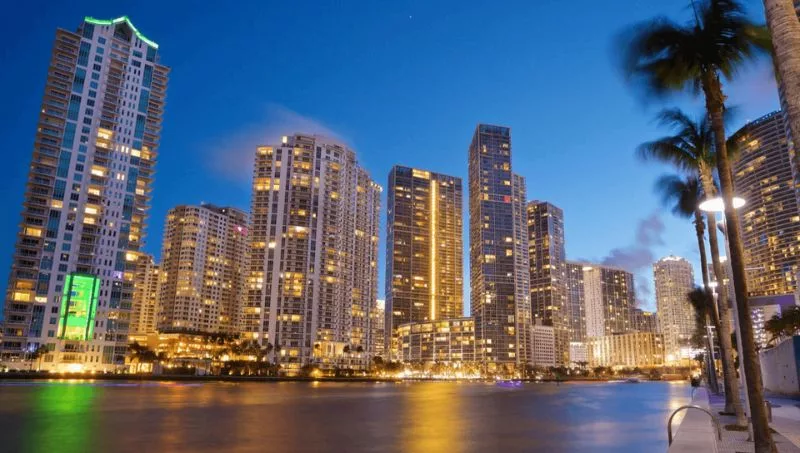

Why is a city so beloved by people who weren’t born there? Why is it a city where everyone feels proud?
-
The answer isn’t complicated. Uniting for the better, for the worse, statism, socialism, communism, cronyism of power ends up generating millions of Latinos who seek a city where that horror will never be voted, denied, distorted, concealed, or justified.
-
In the global economic map, a quiet yet unstoppable tectonic shift is underway: Miami has ceased to be merely the “Gateway to the Americas” and has become the neural epicenter where power, capital, talent, and innovation converge in an unprecedented historical synergy. What we’re witnessing isn’t a trend; it’s a fundamental reconfiguration of the world’s economic order.

The ZIP Code Worth More Than Entire Countries
-
ZIP 33109, the Fisher Island zip, currently bears the title of the most expensive in the world, with a per‑capita income exceeding $2.5 million annually. But this figure, while striking, barely scratches the surface of a deeper transformation. We’re looking at what economist Enrico Moretti calls “The New Geography of Jobs”: the spatial concentration of talent, capital, and opportunities that generates exponential multiplier effects.
-
Richard Florida, in his seminal work The Rise of the Creative Class, predicted that future cities would compete not on manufacturing but on brains. Miami has not only validated that hypothesis; it has taken it to dimensions that exceed any projection. When Amazon, Blackstone, and Google—corporations whose combined market capitalization surpasses France’s GDP—reposition their operations toward Miami, they aren’t following a trend: they’re reading force vectors of the economy that most people are only beginning to grasp.
Geographic Alchemy: Where Hemispheres Collide and Create Value
-
Miami isn’t merely a city: it’s a quantum node where geography is transmuted into unbeatable competitive advantage. Its placement at the intersection of three strategic time zones (EST for Wall Street, GMT-3 for São Paulo, GMT+1 for Europe) makes it the only point on the planet where transactions can flow without hourly frictions for 18 continuous hours of the global business day.
-
Nobel laureate Paul Krugman’s “New Economic Geography” argues that physical location still matters—perhaps more than ever—in a digital economy. Miami perfectly exemplifies his core-periphery model: a metropolitan agglomeration that yields self-reinforcing cumulative advantages. Every company that arrives exponentially increases the attractiveness for the next, creating what physicists call “critical mass” and economists term “network effects.”
The Banking System That Sees Two Worlds at Once
-
Miami’s financial infrastructure acts as a simultaneous translator between banking systems that historically ran apart. With more than 100 international financial institutions, the city processes daily transactions exceeding $3 trillion, functioning as a clearinghouse between European SWIFT and Latin American mechanisms.
-
Niall Ferguson, Harvard economic historian, argues in The Ascent of Money that great financial centers emerge where institutional trust, legal infrastructure, and regulatory sophistication converge. Miami has meticulously built these three pillars, creating what financiers call “regulatory arbitrage”: an environment where American regulatory clarity meets the flexibility needed to navigate Latin American complexities.
Talent Migration: When Titans Vote with Their Feet
-
The data are clear and striking for traditional cities: according to the Migration Policy Institute, Miami experienced the largest net influx of individuals with more than $30 million in wealth during 2020–2024 of any American city. Even more revealing: 67% of these UHNWIs are under 45, contradicting the stereotype of Miami as a retirement hub.
-
Thomas Piketty, in Capital in the Twenty-First Century, argues that spatial inequality will be the great challenge of the 21st century. Miami reflects both the problem and the opportunity: wealth concentration generates gravitational effects that attract ultra-luxury services, top-tier cultural institutions, and economic opportunities that feed the cycle.

Lifestyle as Economic Infrastructure
-
Here lies Miami’s strategic genius: it understood early that in the knowledge economy, lifestyle isn’t an amenity but critical infrastructure. When a CEO can videoconference with Tokyo in the morning, seal a deal with Frankfurt at noon, and finish the day cruising Biscayne Bay, he isn’t indulging a privilege—he’s maximizing his life-work utility in a way that’s nearly impossible in Manhattan or San Francisco.
-
Quality of Life Economics, a concept developed by the Urban Land Institute, posits that cities optimizing climate, culture, diversity, and services disproportionately capture global talent. Miami, with 329 days of sun a year, more than 800 world‑class restaurants, institutions like the Pérez Art Museum and Adrienne Arsht Center, doesn’t merely compete with American cities: it competes with Singapore, Dubai, and Hong Kong.
Diversity as a Quantifiable Competitive Advantage
-
Miami’s demographic makeup—about 70% Hispanic, more than 60 languages spoken, 150 nationalities coexisting— isn’t merely multicultural decoration: it’s informational arbitrage. Each community functions as a real-time market intelligence sensor for its home region.
-
Scott E. Page, University of Michigan, mathematically demonstrated in The Diversity Bonus that cognitively diverse teams outperform homogeneous ones even when the latter have greater average individual ability. Miami corporatizes this advantage: a city‑team that processes global information with unmatched speed and sophistication.
The Theater, Art, and Culture: Social Cement for Advanced Capitalism
-
Miami’s cultural explosion—from Art Basel to Broadway productions, Wynwood to the Design District—isn’t cosmetic fluff: it’s social cement that keeps a global elite community cohesive, otherwise atomized.
-
Sociologist Robert Putnam documented in Bowling Alone that social capital—the networks of trust and reciprocity—is the most valuable asset for prosperous communities. Miami is deliberately manufacturing this capital through cultural infrastructure that creates in-person encounters, conversations, and relationships impossible to replicate online.
The Uneasy Question: Is This Concentration Sustainable?
-
Harvard urbanist Edward Glaeser warns in Triumph of the City that great urban agglomerations inevitably face the paradox of success: congestion costs can overwhelm the benefits of agglomeration. Miami is already feeling this strain: housing prices have surged 87% in five years, road infrastructure shows signs of saturation, and water table concerns threaten vertical expansion.
-
Yet the city demonstrates notable adaptive capacity: investments in Brightline high-speed rail, the development of satellite hubs in Coral Gables and Brickell, and projects like Miami Worldcenter signal strategic planning that anticipates continuous exponential growth.
The New World Order with a Multicultural Accent
-
What we’re witnessing in Miami goes beyond urbanism or regional economics: it’s the crystallization of a new paradigm for social and economic organization. The Italian Renaissance city-states—Venice, Florence, Genoa—were not accidents of geography: they were governance experiments that gave rise to modern capitalism.
-
Miami is writing the next chapter of that story. Not as a city subordinated to a nation, but as an autonomous node in a global network of capital, talent, and ideas. When the world's top billionaires vote with their feet, when the planet’s most sophisticated corporations reposition their gravity centers, when the most valuable human capital chooses where to deploy its potential, they’re signaling something fundamental about how power will be organized in the 21st century.
The Future Has Arrived, It Just Has ZIP Code 305
-
The question isn’t whether Miami will become the No. 1 city in the United States: that metamorphosis has already happened. The pertinent question is which other cities have the vision, political will, and executive capability to replicate even a fraction—
Read Smart, Be Smarter!
Infonegocios Miami: a publication written by the Anglolatina business community.
Follow for more analysis: @InfonegociosMiami
https://infonegocios.miami/suscribite-al-newsletter
Contact: [email protected]
Infonegocios NETWORK: 4.5 million Anglo‑Latinos united by a passion for business.
Join us and stay informed.
Infonegocios Miami—Economic, Cultural, and Business Intelligence with a Global Lens
Follow for more analysis: @InfonegociosMiami
© 2025 Infonegocios Miami.











Tu opinión enriquece este artículo: