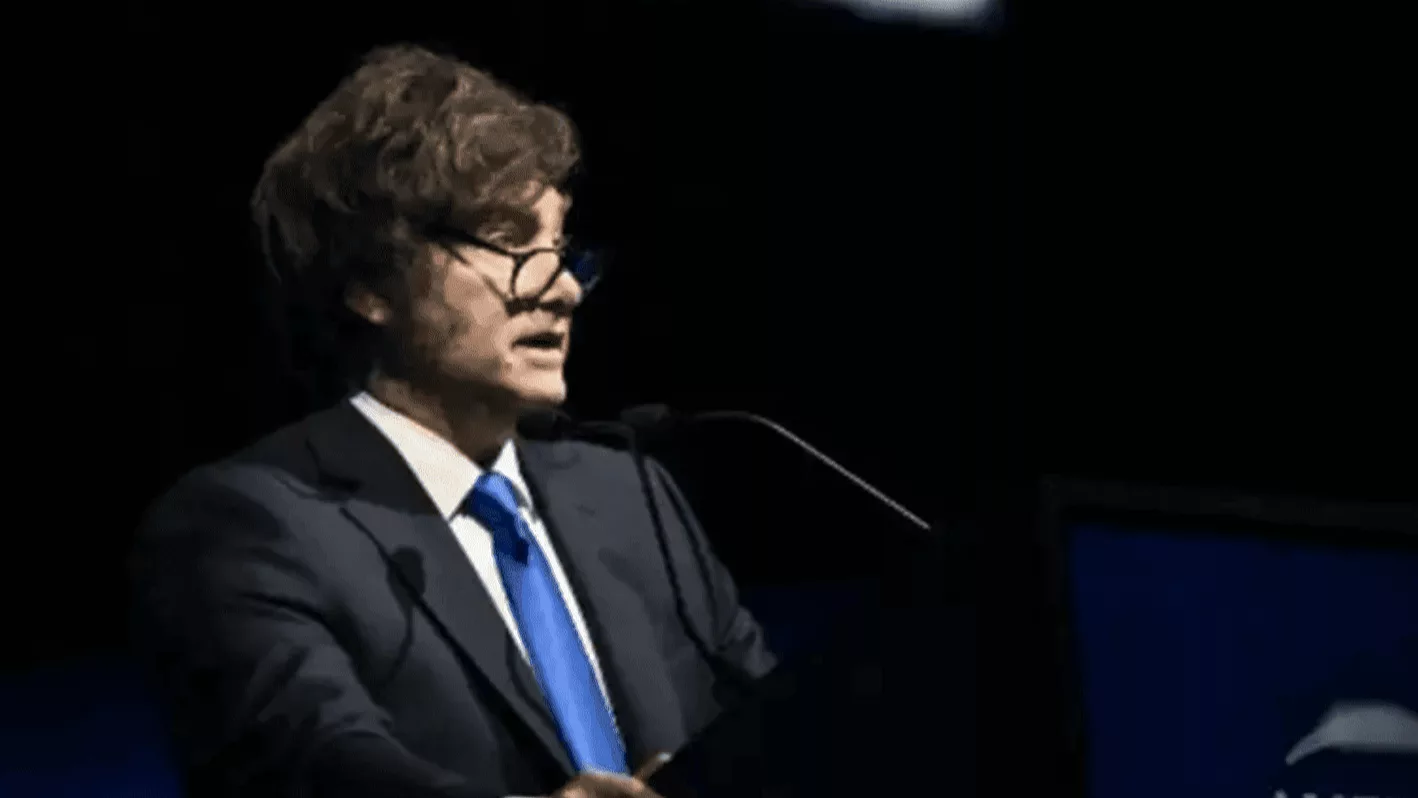
What’s indisputable is that it was more than a presidential address: it was catharsis—interwoven with a crisp, assertive explanation of a national plan projected onto the international stage. It was Argentina speaking to itself—the paradox of a country that needs to step beyond its borders to believe in its future—and a warning about the risk that nations and cities like New York face when they fall into socialist hands, which, inevitably, ends badly.
Argentina’s president transformed the American Business Forum into a manifesto for a nation attempting, once again, to escape its own historical labyrinth.
Miami was no accident. And what better stage than a city where 250,000 Argentines have built the version of Argentina they once thought impossible in their homeland?

THE THEOLOGY OF THE MARKET: WHEN ECONOMICS BECOMES RELIGION
-
“Capitalism is not a necessary evil; it is pure justice,” Milei proclaimed with a fervor more reminiscent of an evangelical preacher than a University of Belgrano–trained economist. It’s no casual metaphor: Milei is articulating what sociologist Max Weber would call a Protestant ethic of capitalism—updated for the 21st century and the Argentine temperament.
-
His argumentative construction is sophisticated. He begins from a correct premise: capitalism has indeed lifted billions out of absolute poverty. As Nobel laureate Angus Deaton documents in The Great Escape, the global reduction in poverty since 1820 is historically unprecedented and directly correlated with the expansion of trade and free markets.
-
But Milei goes beyond empirical evidence to enter the metaphysics of the market. “We don’t have many natural rights in this life beyond the right to own the sweat of our brow,” he asserted, invoking John Locke. As political philosopher Michael Sandel notes in Justice, natural-rights theory is far more complex: what about those who cannot work? Do the disabled, children, and the elderly not possess natural rights?
-
The audience at the Kaseya Center—successful business leaders, self-made entrepreneurs, Argentines who fled statism—applauded enthusiastically.

Milei was cheered as much as Messi—and that says a lot.
Yet there was a deep irony in that applause: many of those entrepreneurs built fortunes by leveraging state subsidies, trade protection, or government contracts in Argentina in the 1990s and 2000s. And, regrettably, across many Argentine provinces there are still business elites tied to statist, Peronist power structures who benefit from the country’s stagnation—who prefer that the massive state employing 30% of the workforce not shrink, and who have cultivated a culture defending an all-powerful state that decides who is “talented” and who is not—too often yielding mediocrity, injustice, polite totalitarianism, and poverty, masked by a denialist “localism.”
THE “KUKA RISK” AND THE ELECTORAL WIN: A RESISTANCE NARRATIVE
-
Milei devoted a substantial portion of his remarks to celebrating the October 2025 legislative victory, describing it as a “historic triumph” proving that “Argentines responded” despite the “economic blow the opposition tried to deliver from Congress.”
-
This heroic-resistance framing against shadowy forces is classic populism. As Ernesto Laclau analyzes in On Populist Reason, populist leaders build legitimacy precisely through narratives of struggle against a conspiring establishment.
-
What Milei calls the “KUKA risk”—a derogatory reference to Kirchnerism—is politically brilliant framing: it personalizes the adversary, demonizes it, and simultaneously casts himself as the victim. “For months it was the greatest obstacle to the economic program,” he claimed, attributing difficulties to opposition sabotage.
-
However, independent economists like Martín Guzmán (former economy minister) and Ricardo Arriazu point out that Argentina’s economic problems are structural and decades in the making—not the product of maneuvers by a single political faction. The 211% annual inflation Milei inherited in December 2023 stemmed from fifty years of irresponsible monetary issuance, not a Kirchnerist conspiracy.
-
But for the Miami audience—particularly Argentines living in confirmation bubbles where everyone thinks alike—Milei’s narrative is cathartic. “We finally have a president who tells it like it is,” says Mónica Fernández, an accountant based in Aventura. “Kirchnerism destroyed Argentina, and now they’re trying to destroy the one who wants to fix it.”
THE COMEBACK IN BUENOS AIRES: SYMBOLISM AND REALITY
-
Milei placed special emphasis on the victory in Buenos Aires Province, where “we clawed back a gap of more than 14 points.” It’s symbolically crucial: Buenos Aires accounts for 37% of the national electorate and has historically been a Peronist/Kirchnerist stronghold.
-
As political scientist Sergio Berensztein notes, this victory reflects the middle class’s exhaustion after decades of decline. The province that prospered in the 1950s and 60s is now marked by rising poverty, endemic insecurity, and crumbling infrastructure. The vote for Milei was less ideological adhesion than a desperate cry of “throw them all out.”
-
For Argentines in Miami, the win carries special meaning: it validates their decision to leave. “If even Buenos Aires voted for change, it means we weren’t crazy to go,” reflects Eduardo Constantini (not to be confused with the art magnate), an engineer who emigrated in 2018. “The entire country realized the previous model was unsustainable.”
Infonegocios Miami — Donde la Política Global Encuentra el Negocio Local
🗳️ Síguenos para cobertura en tiempo real: @InfonegociosMiami
Infonegocios Miami —
www.InfonegociosMiami.com/beckham
⚽ Síguenos para más análisis: @InfonegociosMiami
Read Smart, Be Smarter.
Infonegocios Miami—Economic, Cultural, and Business Intelligence with a Global Lens

© 2025 Infonegocios Miami.
Read Smart, Be Smarter!
https://infonegocios.miami/suscribite-al-newsletter
Contact: [email protected]
Infonegocios NETWORK: 4.5 million Anglo-Latinos united by a passion for business.
Join us and stay informed











Tu opinión enriquece este artículo: