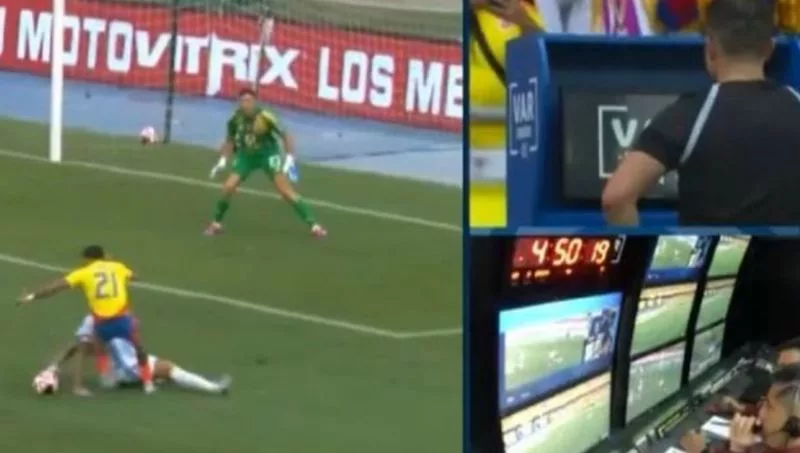
The penalty was contentious for several reasons. To begin with, the VAR predominantly presented a static image of the contact, failing to delve into the context of the action. This, of course, distorted the referee's view, who ultimately awarded the penalty. Moreover, the video clearly shows Muñoz diving in response to the tackle from the Benfica player, with no evident foul taking place.


-
The initial audio review did not indicate a penalty, but later claimed that the lifted foot had brought down the opponent. The problem is that the video shows a significant gap in time between the Argentine player’s foot movement and the Chilean player’s jump, suggesting clear simulation—yet, let’s consider Scaloni’s perspective:
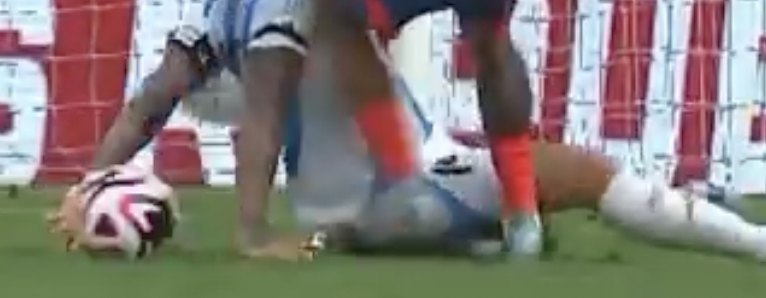


Although he tried to avoid discussing the referee's performance, the Argentine coach referenced the play that changed the match. “The five VAR officials saw a penalty, that’s it. I honestly don’t see a penalty, but soccer is a sport that requires awareness of your surroundings. What Muñoz did says it all; he doesn’t protest at any moment, but it’s welcome for his team,” he emphasized. “I told him that on the sidelines, and he laughed. It’s clear that the penalty influenced the match,” concluded Scaloni.

-
The critical questions arise: What do Colombian fans see when they view this play? What do Argentinians perceive? What does a Latino who dislikes Argentina or hopes for their loss observe? What does a Venezuelan rooting for Colombia's defeat see?
Watch the video here:
https://www.instagram.com/reel/C_ySHOVumDM/?utm_source=ig_web_copy_link&igsh=MzRlODBiNWFlZA==
-
Now, the pressing inquiry is how the VAR perceived what it did. Will there be a review from CONMEBOL? And although it may not be FIFA's direct responsibility, can this incident serve as a lesson to ensure such blatant injustices do not recur?
-
What role does the press, whether Colombian, Argentine, or from elsewhere, play in these situations?
Frequently Asked Questions:
Why can fanaticism be detrimental to sports?
Fanaticism blinds fans, preventing an objective assessment of critical situations that may arise during the game.
How do referee decisions influence players' psychology?
Referee decisions can alter a team's confidence and performance, impacting their play throughout the match.
What role does technology, like VAR, play in game perception?
While VAR aims to enhance fairness in sports, its implementation has generated criticism and confusion, particularly at decisive moments.
-
The recent controversy surrounding the penalty awarded to Colombia highlights the need for a deeper analysis of how referee decisions and technology impact game performance and perception. With a focus on critical thinking, and bolstered by insights from neuroscience, this article aims to unravel the complexities of sports fanaticism and provide tools for a more critical and less emotional understanding of soccer.
The Context of the Penalty
During the match between Colombia and Argentina, a penalty awarded by referee Piero Maza after a VAR review sparked widespread indignation. The decision, which ultimately affected the outcome, was based on an interpretation of the foul committed by Nicolás Otamendi against Colombian Muñoz. The controversy intensified with the release of VAR audios, revealing the decision-making process behind this contentious call. Argentine coach Lionel Scaloni expressed his discontent, emphasizing that the penalty was decisive in an otherwise balanced game. This reaction reflects the frustration many fans feel when referee decisions impact the final result.
The Impact of Fanaticism
Fanaticism, in its purest form, is a manifestation of human passion. However, in sports, it can become an obstacle to objectivity. Often, fans become ensnared in an emotional spiral that impedes their ability to analyze the game clearly. This lack of objectivity can have repercussions not only for fans but also for players and referees.
The Psychology of the Fan
From a neuroscience perspective, fanaticism can be understood as a psychological phenomenon that activates specific brain circuits associated with reward and emotion. When a fan cheers for their team, their brain releases dopamine, the pleasure hormone. This phenomenon can lead to a form of “blindness” that hinders critical evaluation of complex situations, such as the disputed penalty.
The Influence of VAR
-
The use of VAR has been an attempt to introduce fairness into soccer, but its implementation has generated confusion and disagreement. The VAR audios from
the mentioned match reveal a process that may be perceived as arbitrary by fans. The question arises: how can a system designed to enhance fairness generate even more controversy?
The key may lie in perception. When fans witness a decision that contradicts their initial understanding of the game, they can react emotionally. This is particularly relevant in critical moments, such as a penalty that could determine the outcome of a match.
Advice for a New Perspective
Foster Empathy: Attempting to understand decisions from the perspective of referees and players can help mitigate frustration. Remember that referees are human and can also make mistakes.
Critical Analysis: Instead of reacting impulsively, it’s advisable to pause and analyze the situation from a more objective standpoint. Asking what the decisions mean for the overall game can provide a clearer view.
Education in Soccer: Promoting education about the rules of the game and the functioning of VAR can help fans better understand what happens on the field and why certain decisions are made.
-
Will there be a review of the match, the outcome, the VAR process?
-
Will the international press and fans learn anything, or will everything continue as it has, tarnishing not only the sport but society as a whole?
-
Will there ever be a gesture of apology from a national team, a referee, or a coach acknowledging that something was incorrectly called?


-
Registrate sin cargo, y recibe el newsletter solo dejando tu mail y nombre aquí.
-
Sign Up for Free: Register and receive our newsletter by simply leaving your email and name here. (https://infonegocios.miami/suscribite-al-newsletter)

-
IG: @infonegociosmiami
Infonegocios RED: 4.5 Millones de anglolatinos leyendo diariamente las noticias del mundo de los negocios
Infonegocios RED: 4.5 million Anglophone Latinos reading business news daily.
Contacts: [email protected] or [email protected]












Tu opinión enriquece este artículo: