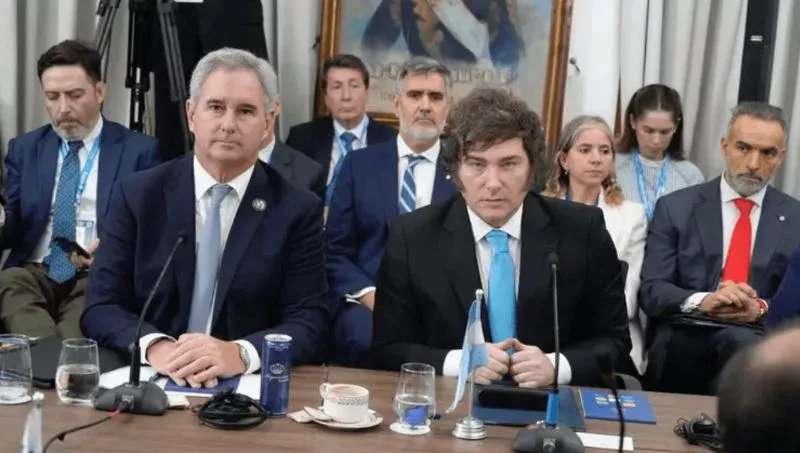

What follows is a pure textual analysis—no embellishments—where each of Milei's statements is examined as a specimen under a geostrategic microscope.
The Moment Discourse Ceased to be Rhetoric and Became an Institutional Death Certificate
December 20, 2025, will enter the annals of South American history as the day a president used the Mercosur podium not to celebrate, but to perform a live autopsy.
The Question No One Dared to Ask
"Do we want a Mercosur that is an engine for growth or a brake on the future?"
Textual Analysis: This binary question operates as a device of unmasking. It permits no ambiguity, forcing a choice between two exclusive identities: engine (dynamism) or brake (paralysis). It is the perfect rhetorical trap: choosing "brake" self-identifies as an enemy of progress; choosing "engine" necessitates accepting all reformist implications.
Historical Context: In 34 years of Mercosur summits, no leader had presented such a brutal dichotomy. The discourse always centered on "deepening," "improving," "strengthening"—verbs presupposing life. Milei used verbs presupposing a final judgment: to be an engine or to be a brake.
The Incontrovertible Diagnosis
"It was born with a clear mission: to promote trade, increase prosperity, integrate markets, and elevate the competitiveness of our societies. And none of those core objectives have been met."
Textual Analysis: The structure is thesis-antithesis without synthesis. First, it enumerates the five founding objectives (1991, Treaty of Asunción), then applies the verb of death: "have not been met." It does not say "partially met" or "need adjustments." It says "none"—absolute, total, definitive.
Data Substantiating the Assertion:
-
Intra-bloc trade as % of total: 25.1% (1998) → 13.8% (2024) — a 45% decline (source: INTAL-IDB).
-
Economic convergence: The Argentina/Brazil GDP per capita ratio was 1:1.2 in 1991; today it is 1:3.5 — divergence, not convergence.
-
Normative harmonization: Only 11% of Mercosur directives have been uniformly incorporated (ECLAC, 2024).

The List of Absences
"There is no common market, no effective free movement, no macroeconomic coordination, no real normative harmonization, no significant increase in internal trade, no sufficient openness to the world."
Textual Analysis: Six consecutive "no's." A hammer-blow structure. Each "no" dismantles a pillar of Mercosur mythology. This is the rhetorical technique of deconstruction by accumulation: repetition not as emphasis, but as forensic evidence.
Figures Certifying Each "No":
-
Common market: The common external tariff has 12,000 exceptions—it's common in name only.
-
Free movement: An Argentine citizen needs 7 procedures to work in Brazil vs. 1 in Chile (OECD).
-
Macro coordination: Argentina inflation 200%, Brazil 4%, Paraguay 5%—coordination is impossible.
-
Normative harmonization: A laptop requires 15 different certifications to circulate in the four countries.
-
Internal trade: Represents 0.8% of combined GDP vs. 3.5% in ASEAN.
-
Global openness: Mercosur has 1 FTA with a developed country (Israel); Chile has 32.

Bureaucracy as the Sole "Success"
"Yes, there is an oversized and ineffective bureaucracy that has expanded upon itself."
Textual Analysis: The solitary "yes" following six "no's" functions as a tragicomic punchline. It confesses the only achievement: creating a bureaucratic apparatus. The phrase "expanded upon itself" is semantic genius, describing an organism feeding on its own fat—an institutional cancer.
Quantified Cost:
-
Mercosur structure: 3,200 permanent officials.
-
Annual cost: US $580 million (source: Internal Audit 2024).
-
Comparison: The Pacific Alliance (Chile, Peru, Colombia, Mexico) operates with 80 officials and generates 4 times more trade.
The Quantitative Imperative
"Reality is not debated, it is measured."
Textual Analysis: Seven words that constitute an entire epistemological manifesto. A brutal juxtaposition between "debating" (subjective, debatable activity) and "measuring" (objective, verifiable activity). It is a declaration of war against the culture of endless discussion.
Immediate Practical Application: In that very room, while the final declaration was being "debated," measurable data stated:
-
Average time to approve a Mercosur norm: 4.2 years.
-
Implementation rate: 23%.
-
Cost of non-integration: 2.1% of regional GDP annually.
The Evaporating Trade
"Intra-bloc trade as a proportion of total trade is today far below its historical levels, despite Mercosur's external tariffs being among the highest in the world."
Textual Analysis: Here, two perverse phenomena are united in an implicit causal relationship: high external tariffs do NOT protect internal trade; they suffocate it. The expected logic would be: "more protection → more internal trade." Reality shows: "more protection → less internal trade."
Statistical Paradox:
-
Average Mercosur external tariff: 13.5% (WTO, 2024).
-
Global average external tariff: 6.3%.
-
Result: Intra-bloc trade falls while extra-bloc trade—despite high tariffs—increases via smuggling and under-invoicing.
The Tariff as a Job Destroyer
"A tariff like that does not protect employment, it destroys it."
Textual Analysis: A seven-word phrase that overturns 70 years of protectionist dogma. Perfect antithetical structure: "protects" vs. "destroys." It is not an assertion; it is an economic law stated as a self-evident truth.
Concrete Example from the Day Before the Address:
-
Argentine footwear sector: 35% tariff on extra-bloc footwear.
-
Expected result: Protection of national employment.
-
Real result: 45,000 jobs lost in 10 years (INDEC).
-
Mechanism: National prices +35% → consumption falls 40% → factories close.

Reform as the Only Option
"Today more than ever, the bloc needs comprehensive reform that reduces Mercosur's economic cost. Integration must serve trade, not bureaucracy."
Textual Analysis: It defines reform not as improvement, but as cost reduction. It shifts the paradigm from "how to do more Mercosur" to "how to make Mercosur less costly." The second sentence establishes a hierarchy of purposes: trade first, bureaucracy never.
Calculation of the "Mercosur Cost":
-
Direct (budget): US $580 million/year.
-
Indirect (non-tariff barriers): US $12 billion/year (ECLAC).
-
Total: 2.1% of regional GDP = US $100 billion annually.
Undervalued Strategic Assets
"Our countries possess extraordinary strategic assets: energy, critical minerals, and food. What we need is to stop creating internal obstacles and allow that potential to unfold."
Textual Analysis: From criticism to opportunity. It enumerates three assets aligned with three global crises: energy (energy transition), critical minerals (digital revolution), food (food security). It then identifies the enemy: "internal obstacles"—not external ones.
Quantified Potential vs. Reality:
-
Energy: We could export gas for 100 million Europeans; we export for 5 million.
-
Critical Minerals: We hold 40% of the world's lithium; we produce 15%.
-
Food: We could feed 1.5 billion people; we feed 450 million.
Flexibility as an Asset, Rigidity as a Threat
"Flexibility is an asset, not a threat. Rigidity can only bring stagnation."
Textual Analysis: A perfect dichotomy: flexibility=asset, rigidity=stagnation. It rewrites the regional political dictionary, where "flexibility" was always read as "betrayal" and "rigidity" as "coherence."
Historical Example: The 2010 "Expanded Mercosur," which allowed bilateral agreements, was resisted as "dangerous flexibility." Result: countries that used that flexibility (Uruguay with Chile) grew more.
The EU and the Slowness That Condemns Us
"After decades of negotiations, we have not been able to finalize a trade agreement. Our countries do not have another ten years to waste on administrative discussions."
Textual Analysis: "Decades" vs. "another ten years"—a chronology of desperation. It does not speak of "negotiations"; it speaks of "administrative discussions"—a deliberate reduction of the geopolitical to the bureaucratic.
Real Timeline:
-
1999: Negotiations begin.
-
2019: Agreement "closed" at 99%.
-
2025: Still not ratified.
-
Meanwhile: The EU has signed agreements with Vietnam, Japan, Canada, Mexico…**
Venezuela: Unambiguous Moral Condemnation
"It continues to suffer a devastating political, humanitarian, and social crisis. This danger and this shame cannot continue to exist on the continent."
Textual Analysis: Three consecutive adjectives: political, humanitarian, social—a triple crisis. Then two nouns: danger, shame—a dual condemnation. This is not analysis; it is a verdict.
Data Substantiating Each Adjective:
-
Political: 0 free elections since 2015.
-
Humanitarian: 7.7 million displaced (UNHCR).
-
Social: Poverty rate of 94% (ENCOVI 2024).
Support for Trump and the Breaking of a Taboo
"Argentina welcomes the pressure from the United States and Donald Trump to liberate the Venezuelan people."
Textual Analysis: A historic statement. The first time a South American president, in a regional forum, explicitly supports U.S. intervention. It breaks the taboo of automatic anti-imperialism.
Intra-Regional Context: In that same room, Lula had hours earlier stated that U.S. military action would be a "humanitarian catastrophe." Milei does not respond; he counter-proposes.
Kast as Symptom, Not Anomaly
"The victory of José Antonio Kast in Chile expresses a clear social demand for more competitive, open, and flexible economies."
Textual Analysis: It transforms a Chilean national election into a regional symptom. Three adjectives: competitive, open, flexible—exactly the opposite of the current Mercosur.
Raw Electoral Data: Kast won 58% with a program that included:
-
Leaving Mercosur.
-
Signing an FTA with the EU within 12 months.
-
Reducing tariffs to 0% with 90% of the world.
The Peroration: The Choice
"The new South America arrives from the future. It is up to this bloc to decide whether it will move with this tailwind or cling to the mast of the past to fight against the change our countries need and demand."
The Address as a Point of No Return
Milei did not deliver a speech. He wrote the epitaph for one Mercosur and the prospectus for another. Each phrase was:
-
A verifiable diagnosis.
-
An unappealable moral condemnation.
-
A binary proposal.
-
An inevitable outcome.
At the end of the reading, only two paths remain:
-
Accepting that "reality is not debated, it is measured" and reforming everything.
-
Continuing to debate while reality measures and condemns us.
This address will be remembered as the day South America began to choose between measuring or perishing.
The Question That Echoes
Milei's question continues to resonate:
"Do we want a Mercosur that is an engine for growth or a brake on the future?"
The answer will begin to be written at the next summit. Or there will be no next summit.
Read Smart, Be Smarter!
Infonegocios Miami: a publication written by the Anglolatina business community.
Follow for more analysis: @InfonegociosMiami
https://infonegocios.miami/suscribite-al-newsletter
Contact: [email protected]
Infonegocios NETWORK: 4.5 million Anglo‑Latinos united by a passion for business.
Join us and stay informed.
Infonegocios Miami—Economic, Cultural, and Business Intelligence with a Global Lens
Follow for more analysis: @InfonegociosMiami
© 2025 Infonegocios Miami.










Tu opinión enriquece este artículo: