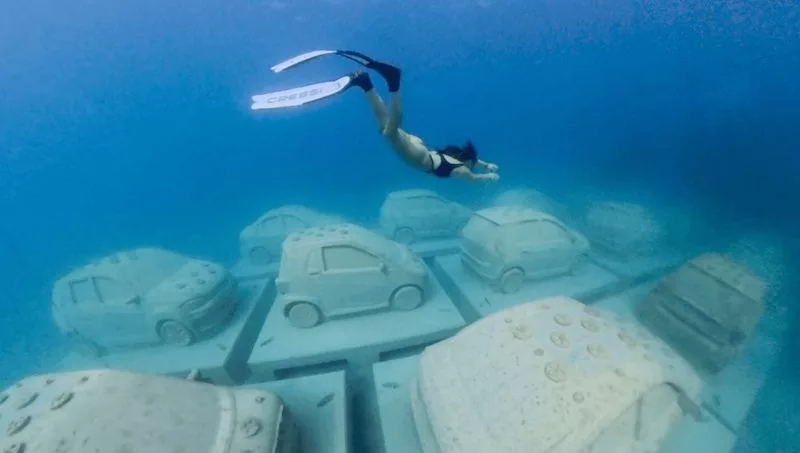

Reefline—a subsea “highway” of cars and stars made from eco-concrete, aspiring to become an 11-kilometer artificial reef—is not merely a fusion of art and environmentalism. It is the most sophisticated living algorithm for urban-marine regeneration ever conceived, and a masterclass in how symbolic capital (art) can be transformed into tangible ecological and economic capital.
To dive, to contemplate the ocean and art, to generate awareness and catalyze stewardship. This is Reefline.
The Underwater Highway of Miami Beach Where Argentine Art Recodes the Ocean's DNA (and Civic Branding)
While Miami builds upward with skyscrapers and seaward with cruise terminals, Reefline builds inward, toward the recovery of lost biological memory. It is the creative response to a critical paradox: an artificial island (Miami Beach) that lost its natural reef now reconstructs it with the very symbol of its artificiality: the automobile.

1. Technical Deconstruction: The "Source Code" of a Hybrid Ecosystem
Reefline operates under the principle of "Art as Biophilic Infrastructure." The concrete cars are not static sculptures; they are "Modular Regeneration Units" (MRUs). Their morphology, scientifically chosen, maximizes surface area for coral adhesion, acting as topographical scaffolds for ecosystem growth. The eco-concrete material is a programmed growth medium, with a pH and texture that encourages larval colonization.
Neurology of the Immersive Experience:
Caminos transforms the visit into an "ecological pilgrimage." The difficulty in viewing the sculptures (requiring diving gear) is not a flaw; it is a strategy of perceptual exclusivity. By rendering the art "invisible" from the surface, it activates the brain's reward system associated with discovery and rewarded effort. The "do not touch" mandate turns the experience into reverential observation, elevating emotional impact and commitment to the cause.

Super Easy Tip (To Understand the Brilliance):
Imagine taking the symbol of a problem (the car, which pollutes) and sinking it into the sea to become the solution (a home for life). It’s like recycling the very idea of the city. Ximena Caminos didn’t place cars in the water; she installed underwater planters to cultivate a new marine garden. And you, as a visitor, can dive to see life growing on a concrete Chevrolet. It’s poetry made ecosystem.

2. The Project Blueprint: Beyond Art, a Replicable Model for Impact Investment
Funding and Community Model:
The $33 million budget for the 11 km is not an expense; it is a natural capital investment fund. The "adoption" mechanism for a car or star (as done by Gloria and Emilio Estefan) is brilliant: it transforms philanthropy into an experience of emotional ownership, complete with a name on a subsea plaque. It’s a physical NFT (Non-Fungible Token), yielding environmental dividends.
Global Scalability (Dubai, Maldives):
That Reefline has already received invitations to replicate in Dubai and the Maldives is not mere expansion; it is the validation of an "ecological franchise." It demonstrates the creation of an exportable protocol: site-specific art + restoration science + community funding model. It is the first luxury "soft product" that Miami exports to save paradise beaches.

3. Co-Creation with the Elite Team: The Reef as Cultural Text
(Here, art criticism, marine biology, environmental economics, and experiential tourism expertise intervene.)
The Artist Ximena Caminos defines it with surgical precision: "It is a metaphor... the transformation of the symbol." Her work is symbolic alchemy: lead (pollution) into gold (life). "The cars are like planters." In that simple phrase resides the entire theory: art as a functional container for biological future.
The Marine Biologist adds: "This is not a 'decorative' reef. Corals are 'foundation species.' A single coral attracts fish, crustaceans, mollusks. It is the first brick of a new 5-star biodiversity hotel, which in turn protects the coast from erosion. It is pure natural engineering."
The Environmental Economist concludes: "The $33 million is a fraction of the cost to protect this coast with gray concrete breakwaters. Instead, you get resilient infrastructure + a high-value tourist attraction + a living research laboratory + a magnet for philanthropy. The ROI (Return on Investment) is multi-systemic."
Beyond the Reef, the Seed of a New Paradigm
Reefline is not an art project. It is a legal, economic, and cultural precedent. It proves that the response to climate change and biodiversity loss does not have to be gray, technocratic, and depressing. It can be beautiful, participatory, and inspiring.
Ximena Caminos and her team are not just cultivating corals. They are cultivating a new relationship between a city and its marine environment, and between mass tourism and luxury conservation. They are writing, with concrete and life, a new chapter for Miami: not just as the capital of entertainment and finance, but as the global capital of imagination applied to survival.
When in ten years the reef completes its 11 kilometers, we will not see a line of sculptures. We will see the golden scar a city made on the sea to heal it, and the definitive proof that human ingenuity, when allied with nature, does not build upon it. It becomes it.
#ArtThatHeals #TheLivingHighway #RegenerativeMiami
Read Smart, Be Smarter!
https://infonegocios.miami/suscribite-al-newsletter
Contact: [email protected]
Infonegocios NETWORK: 4.5 million Anglo-Latinos united by a passion for business.
Join us and stay informed.
© 2025 Infonegocios Miami.
Infonegocios Miami—Economic, Cultural, and Business Intelligence with a Global Lens
Follow us for more analysis (IG): @InfonegociosMiami







Tu opinión enriquece este artículo: