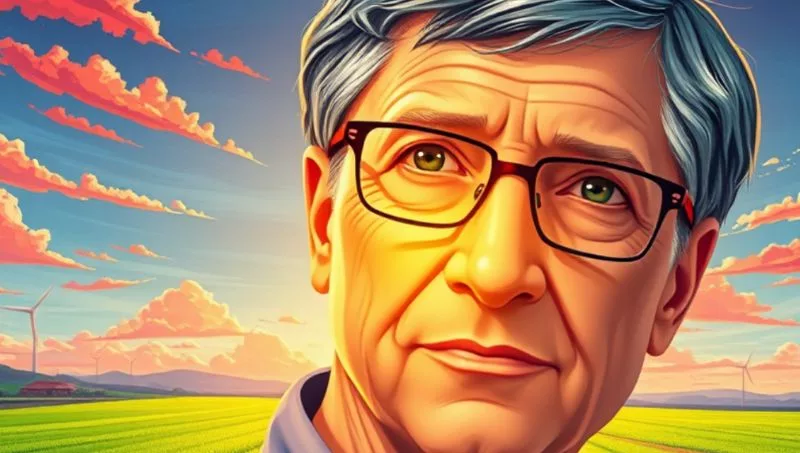
Why is Bill Gates Investing More and More in Farmland? What is His 2025 Strategy Focused on Green Food Technology?

(By Taylor and Rodriguez Otero) What opportunities does this showcase for investors and entrepreneurs? Bill Gates's Investment Strategy in Farmland: A Deep Dive and Its Implications for the Future. In a world where sustainability and smart investing are intertwined, Bill Gates, co-founder of Microsoft and philanthropist, has captured global attention with his growing agricultural portfolio, and in 2025, his bet continues to grow. With over 110,000 hectares across 18 states in the U.S., Gates has become the country's largest individual landowner for years. This article unravels the reasons behind this bold investment strategy, exploring its impact on society, the economy, and the environment, while offering strategic insights for our Anglophone-Latino audience interested in business, society, and marketing.

(High Strategic Value Read: 4 minutes)

Summary and Tips

Bill Gates's investment in farmland is a bold strategy that reflects a long-term vision of financial stability and sustainability. Although his focus is not directly related to the climate crisis, the connection to his green technology initiatives suggests a future where agriculture and innovation are intertwined.


  • Investment in Land: Bill Gates owns 110,000 hectares of farmland in the U.S., an investment that started in 2013 through Cascade Investment.


  • Motivations: The investment is based on the constant appreciation and low volatility of farmland, without a direct relation to the climate crisis.


  • Impact and Future: Although Gates does not alter agricultural practices, his strategy could influence future green technology and sustainability initiatives.


Bill Gates's Investment Strategy

"Since 2013, through his firm Cascade Investment, Bill Gates has been investing in farmland for its constant appreciation and low volatility," Gates declared in a recent Q&A session on Reddit. "My investment group chose to do this. It's not related to the climate crisis."


Relevant Data:


  • Hectares: Gates owns 110,000 hectares across 18 U.S. states.


  • Start of Investment: The investment began in 2013.


  • Appreciation: The average price of farmland in the U.S. has multiplied by six from 1940 to 2015.


"Gates's strategy reflects a broader trend among the super-rich, who have seen farmland as a safe monetary haven since the early 2000s, especially after the financial crisis," notes a Forbes article.

Impact on Society and the Economy

"Investment in farmland is not just a financial decision, but one that can impact food production and wealth distribution," comments economist John Smith 


Relevant Data:


  • Food Production: Gates allows professional farmers to continue working their lands without changes in practices.


  • Conspiracy Theories: Some theories suggest Gates seeks to control food production, though he has debunked these claims.


Gates's strategy of acting as a landlord and not altering existing agricultural practices demonstrates a long-term vision and commitment to the stability of farming communities.

Sustainability and Green Technology

"The connection between farmland investment and Gates's green technology initiatives might be deeper than it appears," suggests sustainability expert María López in an article for GreenBiz on April 12, 2025.

Relevant Data:


  • Productive Seeds: Gates has mentioned the importance of productive seeds to avoid deforestation.


  • Biofuels: The production of biofuels, which heavily depends on corn, was also mentioned by Gates.


Gates's mention of productive seeds and biofuels in his Reddit talk suggests that his agricultural empire could be fertile ground for future green technology innovations. 

Implications for the Future

"Bill Gates's investment strategy in farmland could be a precursor to significant changes in agriculture and sustainability," 


Relevant Data:


  • Ongoing Trend: The amount of arable land in the U.S. is decreasing, which could increase the value of current investments.


  • Innovation: The integration of green technology in agriculture could transform the industry.


"Bill Gates's investment in farmland is not only a bet on financial stability but also a vision of a more sustainable future," concludes an article from The Washington Post on April 13, 2025.

Frequently Asked Questions (FAQs):


Why does Bill Gates invest in farmland?

Gates invests in farmland due to its constant appreciation and low volatility, a strategy that started in 2013 through Cascade Investment.


How does Gates's investment impact food production?

Gates allows professional farmers to continue working their lands without changes in practices, which does not directly alter food production.


Is there a connection between Gates's investments and his green technology initiatives?

Although Gates has mentioned the importance of productive seeds and biofuels, he has not established a direct connection between his land investments and his green technology initiatives.

What future is envisioned for agriculture and sustainability?

The integration of green technology in agriculture could transform the industry, and Gates's strategy could be a precursor to these changes.

Highlighted Tips:


  • Diversify Your Investments: Consider investing in tangible assets like farmland for long-term stability and growth.


  • Leverage Sustainability: Research how sustainability can increase the value of your investments and attract conscious consumers.


  • Stay Informed: Follow global trends in agriculture and green technology to anticipate investment opportunities.


 Follow us on: IG: @infonegociosmiami (Síguenos).


Subscribe for free to receive all strategic information and be part of the largest business and culture community across the Anglophone-Latino world!:

 Contact Infonegocios MIAMI:

 [email protected]

  [email protected]


Read Smart, Be Smarter!


Tu opinión enriquece este artículo:

American Airlines invierte US$ 1.000 millones que revolucionará el Aeropuerto Internacional de Miami (hasta el infinito y más allá)

(Por Taylor, con Maqueda, edición Maurizio) En una jugada que promete transformar el panorama de las aerolíneas y los viajes internacionales en Estados Unidos, American Airlines ha anunciado una inversión de USD $1,000 millones destinada a la ampliación de la terminal D del Aeropuerto Internacional de Miami (MIA). 

(Lectura de valor, 4 minutos de lectura, material idea para compartir)

American Airlines le da otro vuelo a MIA (Miami Internacional Airport)

(Por Taylor, edición Maurizio) La aerolínea ha anunciado una inversión monumental de USD $1,000 millones para la ampliación de la terminal D en el Aeropuerto Internacional de Miami (MIA), un proyecto previsto para iniciar en 2027 que promete transformar radicalmente la experiencia del viajero.

(Lectura de valor, 4 minutos de lectura, material idea para compartir)

Netflix anuncia al mundo que se cae la compra de Warner (y quizás la operación de crossing media más importante de la historia de los medios)

(Redacción Miami) El comunicado oficial de Netflix: “Creemos que habríamos sido grandes administradores de las icónicas marcas de Warner Bros. y que nuestro acuerdo habría hecho crecer la industria del entretenimiento, al mismo tiempo que preservaría y crearía más empleos de producción en Estados Unidos”.

(Lectura de valor, 4 minutos de lectura, material idea para compartir)

El mundo analiza el “algoritmo Messi”: cómo Inter Miami convirtió un 0-2 en un éxito en todo sentido (el verdadero negocio es la remontada)

(Por Ortega - desde Orlando -, con Maurizio) En la MLS 2026, ganar un clásico no es solo sumar tres puntos: es dominar la conversación. Y eso fue exactamente lo que hizo Inter Miami en Orlando: pasó de un 0-2 en media hora a un 4-2 que reescribe el Clásico de Florida y, sobre todo, deja una señal estratégica para toda la liga

(Lectura de valor, 4 minutos de lectura, material idea para compartir)

El código del Ormuz, la apuesta detrás del barril de crudo a US$ 100

(Por Mauvecin, Maurizio y Taylor) Cuando los titulares gritan sobre el estrecho de Ormuz, la mayoría piensa en un mapa, barcos y un cuello de botella. Lo que solo el 0.5% de las mentes estratégicas procesa es que estamos ante el mayor juego de póquer geopolítico desde la Crisis de los Misiles de Cuba, pero con crudo, drones y algoritmos financieros como fichas. 

(Lectura de valor, 4 minutos de lectura, material idea para compartir)

Coca-Cola Argentina lanza latas Mundial 2026 que arrasan entre los hinchas y los kioscos (y contesta a Coca-Cola Brasil)

(Por Maqueda y Maurizio) A 100 días del mundial, las marcas tienen que hacer mucho más que otros mundiales, las que sean sponsor y las que no. Coca-Cola Argentina (algo así como la Coca Cola campeona del mundo), tiene una gran responsabilidad, acaba de lanzar una edición limitada de 5 latas coleccionables para conmemorar el Mundial 2026, con un diseño que fusiona el clásico rojo de la marca y grafismos en azul y blanco.

(Lectura de valor, 4 minutos de lectura, material idea para compartir)

El futuro del branding en la era de la hiper saturación: McDonald's Nueva Zelanda y un ejemplo que es escuela para todos

(Por Rodriguez Otero y Maurizio) Desde McDonald 's hasta Apple, la necesidad de innovación en branding nunca ha sido más crítica. En este entorno, es esencial que las marcas no solo se adapten, sino que también lideren con estrategias audaces y creativas. Entonces que le queda al resto del universo de marcas… solo hacer mucho más de lo que están haciendo hasta ahora y con una estrategia de ecosistema crossing. 

(Lectura de valor, 4 minutos de lectura, material idea para compartir)