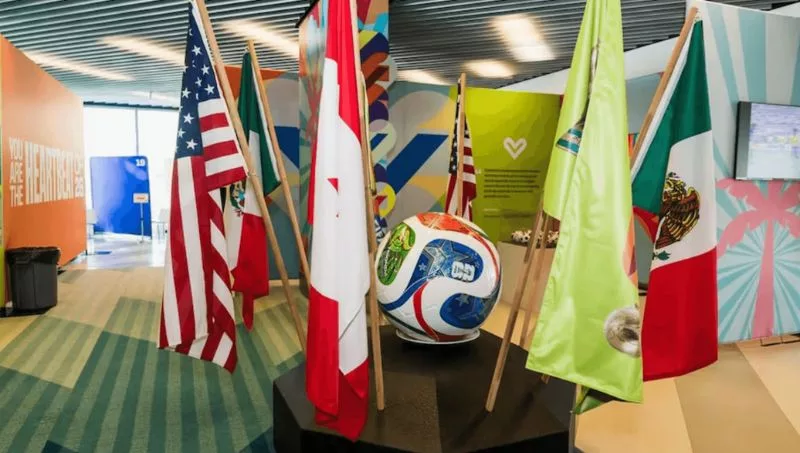
(High-value strategic read, 4 minutes — save it, share it, bookmark it)

The Experiential Branding Revolution That Was Born at Bayfront Park During Copa América Is Now Taking Over the World
There are moments in the history of sports marketing that draw a clear line between before and after. Miami is living one of those moments right now. And it's not coincidence. It's not geography. It's vision.
When Juan Maqueda and his team at agency One, under the conceptual curation of Marcelo Maurizio (LinkedIn) and Sebastián Magistris (LinkedIn) — decided to transform a space in Miami into the AFA Albiceleste Thematic Museum, they weren't simply mounting an exhibition. They were planting a seed that today blossoms into the largest soccer celebration on the planet.
That first immersive, playful, conceptual, and deeply emotional experience — born from Argentina's national team on American soil — was, in essence, the laboratory of the future. A future that FIFA is now embracing at full global scale.

From the First Albiceleste Garden to the FIFA Forest
The AFA Albiceleste Museum was not a museum in the traditional sense. It was a declaration of principles about how soccer should be experienced beyond the pitch. It was the measurable, tangible, emotional proof that fans don't want to be passive spectators — they want to be protagonists of the story.
Juan Maqueda, Executive Director of the Museum, understood this from day one.
Marcelo Maurizio, as Chief of Culture and conceptual curator of that disruptive idea, zeroed in on something that most global brands are still struggling to decode:
"Soccer isn't watched. Soccer is lived, smelled, touched, cried over, remembered, shared, and celebrated. The experience IS the message. We created so many touchpoints — across every format — that we managed to unite three generations at every phase of the experience, where thousands of stories were shared centimeter by centimeter. People got emotional, locked into their shared passions, and connected with each other. That is priceless today — for people and for brands."
That philosophy — brought to life through the handcrafted, strategically precise work of agency One — turned Miami into the first major next-generation experiential soccer branding lab in the Americas.
"It was incredible to see Mexican, Colombian, and Argentine kids playing together, hugging, sharing caps or mini balls, taking photos with historic jerseys. We witnessed things nobody would have predicted — like when Uruguayan and Argentine streamers ran two and three-hour live programs narrating the history of soccer balls as explained in our infographic murals." — Juan Maqueda, CEO of ONE
📌 Don't miss this full report: Miami Vibra Fútbol con el Museo Albiceleste
And today, FIFA is taking notes. And acting accordingly.
Bayfront Park: The Epicenter of a New Era
The FIFA Fan Festival™ Miami will transform over 40,500 square meters of Bayfront Park into what experience design experts call a "total brand ecosystem" — a space where every element — architectural, sensory, cultural, digital, and human — speaks the same language.
From June 13 to July 5, 2026 — 23 consecutive days — the heart of Miami will beat to the rhythm of the ball. With capacity for up to 30,000 fans daily and a main stage for 10,000 people, the scale of this event transcends any previous comparison.
But what's truly revolutionary isn't the square footage. It's the architecture of the experience.
Diego Cánepa, host journalist who — alongside Ambassador Sergio Goycochea — co-created hundreds of pieces of content distributed across media throughout the Americas and the world.

We recall the Copa América Final — Colombia vs. Argentina — when nearly 15,000 people gathered at the Museum's giant screen in what became an iconic, historic moment: the first fanzone in history to fully integrate a thematic, playful, experiential museum with a VIP ecosystem, press conferences, brand boutique, private and mass events, trophy exhibitions, streaming, and a dedicated content studio.
The Pillars of Experiential Branding That FIFA Is Now Scaling Globally
1. Participation as Identity: Faces of Fan Festival
The Faces of Fan Festival installation is perhaps the most conceptually powerful piece of the entire festival. A participatory artwork that gathers images and messages from attendees inside an interactive visual collage — designed to endure as a lasting legacy of the tournament.
From the lens of modern branding theory, this directly addresses one of the most solid principles in consumer neuroscience: people don't remember what they saw. They remember what they felt and what they did. When the fan becomes part of the artwork, the brand permanently tattoos itself into their emotional memory.
📌 Watch this video — it says and shows everything
This concept didn't originate in offices in Zurich. It was born — in its purest, most Latin American form — in projects like the Museo Albiceleste, where the visitor's identity merged with the identity of the national team. Where the fan stopped being a consumer and became a co-creator.

2. Territory as Brand: Miami as Cultural Platform
Both the AFA Albiceleste Museum and the FIFA Fan Festival™ understand something that conventional marketing consistently overlooks: physical space is a communication medium.
Bayfront Park isn't just a venue. It's a canvas. It's the city telling the world: "This is who we are. This is what we celebrate. You belong here."
Miami-Dade County Mayor Daniella Levine Cava captured it with both political precision and genuine brand truth:
"Bayfront Park will be the place where we show the world who we are."
And City of Miami Mayor Eileen Higgins added the emotional dimension that completes the concept:
"A waterfront space where families, residents, and visitors can come together to celebrate soccer and the spirit that makes our city one of a kind."
In terms of city brand positioning, this is exactly what One and Marcelo Maurizio proposed when they designed the Albiceleste experience: make the space speak for the brand before the brand has to speak for itself.
3. Culture as Content: One Game, One Passion
The official campaign "One Game, One Passion" — a host city initiative — is not simply a tagline. It's a declaration of shared cultural identity that transcends flags, languages, and generations.
This is the highest tier of thematic branding: when the campaign stops being advertising and transforms into collective feeling.
The Maqueda–Maurizio–Magistris team has worked for years at the intersection of popular culture, national identity, and brand experience. The Albiceleste Museum was their grand manifesto on American soil. The FIFA Fan Festival is the confirmation that their path was the right one all along.
4. Inclusion as Strategy: Access, Wellbeing & Community
One of the smartest — and most frequently underestimated — elements of large-scale experience design is the architecture of wellbeing: shaded zones, hydration stations, universal accessibility, integrated safety protocols.
Because an experience that excludes, fails. An experience that exhausts, disappoints. An experience that protects and cares for people — builds loyalty.
The FIFA Fan Festival™ Miami has embedded these principles not as logistical obligation, but as part of the event's experiential DNA. And that fundamentally changes how attendees perceive and remember the FIFA brand.
The Network That Expands the Experience: Miami-Dade Parks
The vision doesn't stop at Bayfront Park. The FIFA World Cup 2026 Miami Host Committee has designed a public broadcast network that turns multiple neighborhoods into living extensions of the festival:
|
📍 Location |
Match |
|
Palmetto Golf Course |
Colombia vs. Portugal — June 27 |
|
Little Haiti Park & North Beach Sand Bowl |
Third Place Match — July 18 |
|
Amelia Earhart Park, North Beach Sand Bowl & Tropical Park |
The Grand Final — July 19 |
This decentralized experiential strategy is, in itself, a profound act of branding. FIFA doesn't arrive in the city. It becomes the city.
And that is exactly what happened — at a more intimate but equally powerful scale — when the AFA Albiceleste Museum took a space in Miami and transformed it, for its entire run, into Argentine territory. Into emotional territory. Into a territory of belonging.
The Legacy: What Was Born at One Is Now Being Scaled by the World
It would be easy — and wrong — to see the FIFA Fan Festival™ Miami as just a massive sporting event. Those of us who speak the language of experiential branding know it's so much more than that.
It is the institutionalization of a philosophy that agencies like One, thinkers like Marcelo Maurizio, and executors like Juan Maqueda and his team began building when nobody else was betting on that path in Latin American soccer.
The Albiceleste Museum proved it was possible. That fans responded. That emotion could be designed. That culture could be curated. That soccer could be art, installation, narrative, and lived experience — all at once.
FIFA 2026 confirms it at planetary scale.
Conclusion: Miami, Global Capital of Soccer Branding
What is about to happen at Bayfront Park is not just the biggest Fan Festival in history. It is the global consecration of an experiential branding model that was prototyped right here — in this city, in this park, with this team.
Miami didn't just host a soccer event. Miami invented a new way to experience it.
And the world is finally catching up. ⚽🔥🌎
— Infonegocios Miami Editorial Team
Read Smart, Be Smarter!
https://infonegocios.miami/subscribe-to-newsletter
Contact: [email protected]
Infonegocios NETWORK: 4.5 million Anglo-Latinos united by a passion for business. Join us and stay informed. © 2026 Infonegocios Miami.

www.Infonegocios.Miami Infonegocios Miami — Economic, Cultural, and Business Intelligence with a Global Lens






Tu opinión enriquece este artículo: