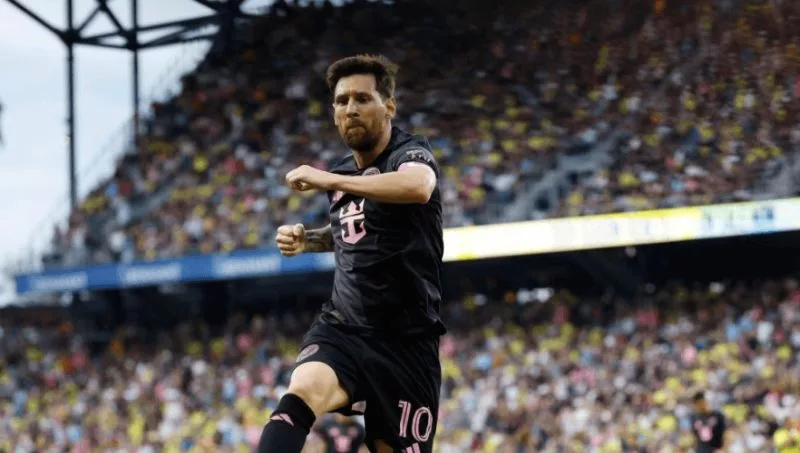

There are moments in sports history when numbers transcend statistics and become existential statements about the limits of human capability. On October 19, 2025, when Lionel Messi scored a hat-trick in Inter Miami’s 5–2 win over Nashville—reaching 29 goals in the MLS regular season and securing the Golden Boot—it wasn’t just another masterpiece from the greatest footballer of all time. It was the scientifically inexplicable confirmation that the Argentine genius operates under biological, physical, and mental coordinates unlike the rest of our species.
At 38—an age when most professionals are retired or winding down in secondary leagues—Messi doesn’t just lead MLS in goals; he dominates it with statistical authority that humbles any historical comparison. Twenty-nine goals and 19 assists in just 28 matches amount to 1.71 direct goal contributions per game—numbers he didn’t sustain over a full season even in his Barcelona prime.
-
“At 38, the Argentine captain proved once again that his impact is total: he shattered records, claimed the Golden Boot, and keeps Inter Miami among the title contenders.” Accurate as that is, it fails to capture the scale of the statistical, biological, and sporting anomaly that Messi represents.
When genius defies biology and permanently redefines American soccer
The anatomy of an impossible season: records that will reshape MLS for decades
Messi’s 2025 numbers aren’t merely impressive; they are objectively unfathomable under conventional sports analysis frameworks.
Watch this goal:
Record 1: First player in MLS history with 10 multi-goal matches in a single regular season
Messi surpassed legends like John Stern, Mamadou Diallo, and Zlatan Ibrahimovic, who shared the previous mark with 8. This means that in 35.7% of his appearances, Messi scored 2 or more goals. For context: MLS’s historical rate is under 12%.
Record 2: First player to lead both goals and assists in the same season
The closest precedent dates to 2015, when Sebastian Giovinco posted 22 goals and 16 assists with Toronto FC. Messi not only surpassed both tallies; he pulverized them while maintaining a superior efficiency ratio in fewer games. Giovinco needed 33 appearances; Messi, just 28.
Record 3: Largest gap to the second-highest scorer in a competitive season
Denis Bouanga (LAFC) and Sam Surridge (Charlotte FC) finished with 24 goals each. Messi’s five-goal cushion represents a 20.8% differential—the largest since MLS implemented its current competition format in 2012.
Record 4: Second Argentine to win the Golden Boot—and the first to do so emphatically
Valentín “Taty” Castellanos took the honor in 2021 with NYCFC after scoring 19—respectable, but dwarfed by Messi’s 29. The 52.6% gap between those performances underscores that this isn’t incremental evolution; it’s a quantum leap in individual output.

The science behind the impossible: how Messi defies the athletic decline curve
Sports physiology sets seemingly immovable principles for performance and age. Dr. Michael Joyner, a Mayo Clinic physiologist and global authority on elite human performance, documents that maximum aerobic capacity (VO2 max) declines roughly 10% per decade after age 30, with accelerated losses past 35.
Sprint speed, explosiveness, recovery between max-effort bursts, muscle elasticity, bone density, metabolic efficiency—every biological marker relevant to elite footballers—follows predictable, well-documented downward trajectories. Cristiano Ronaldo, the only contemporary comparable for elite longevity, shows clear statistical decline after 37 despite legendary discipline.
So how does science explain Messi 2025? Short answer: it can’t—at least not fully. But there are compelling hypotheses:
Supremacy of football intelligence over raw athleticism
Messi was never the fastest, strongest, or fittest. He has always been the most tactically intelligent, with visual-spatial processing and split-second decision-making that sports neuroscientists consider a statistical outlier. As physical capacity declines, his brain compensates—anticipating play with a widening temporal advantage over opponents.

Dr. Jochem Blom, a cognitive neuroscientist at Utrecht University who studied Messi specifically, found that his visuospatial processing “operates approximately 0.3–0.5 seconds faster than the average professional footballer.” In a fractional-speed sport like football, that edge is enormous.
© 2025 Infonegocios Miami.
Read Smart, Be Smarter!
https://infonegocios.miami/suscribite-al-newsletter
Contact: [email protected]
Infonegocios NETWORK: 4.5 million Anglo-Latinos united by a passion for business.
Join us and stay informed









Tu opinión enriquece este artículo: